Bryggen Hanseatic wharf — UNESCO Bergen guide (visit before the cruise crowds)
Bergen: Past & Present Small Group Guided Walking Tour
What is Bryggen and is it worth visiting in Bergen?
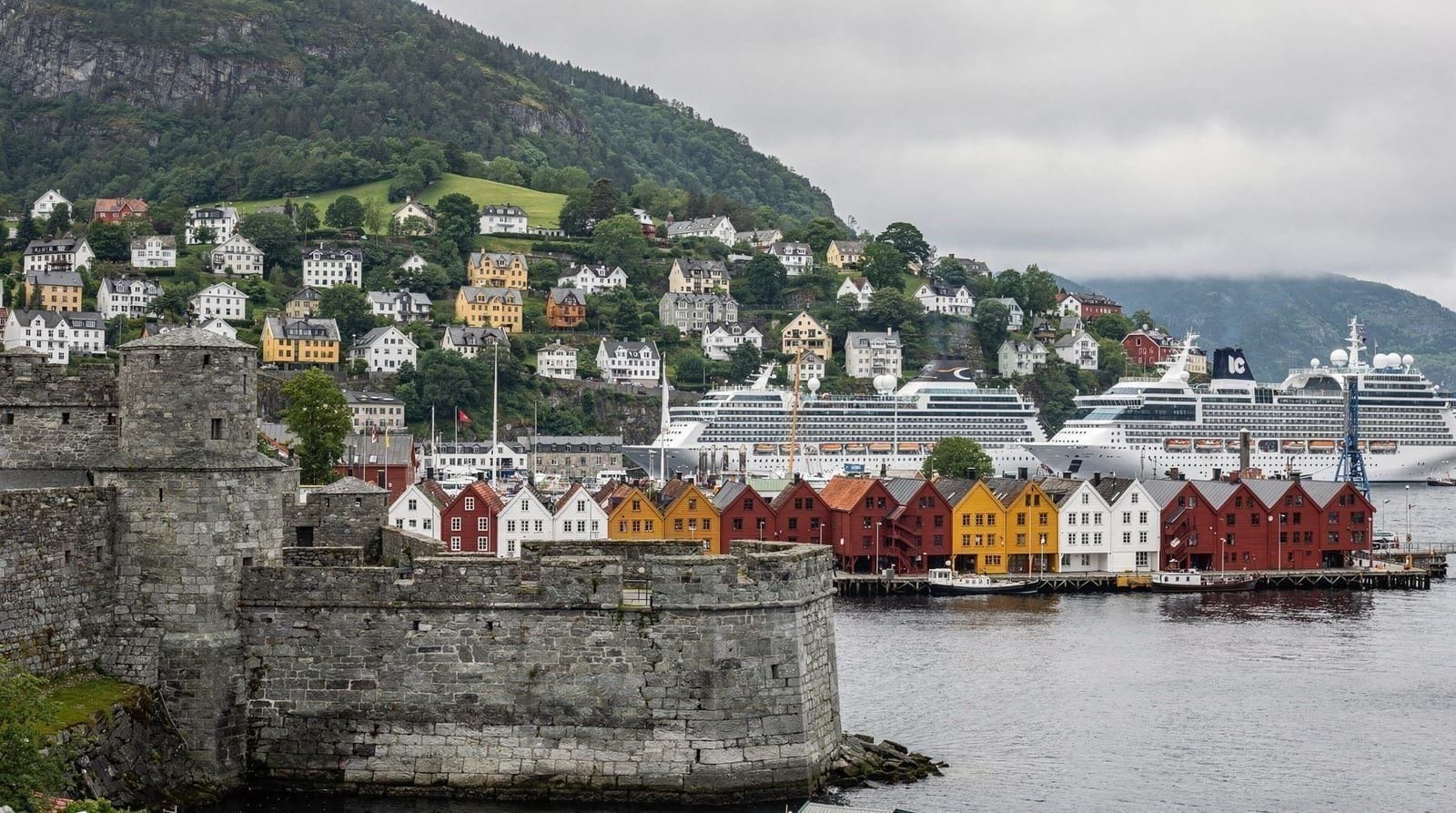
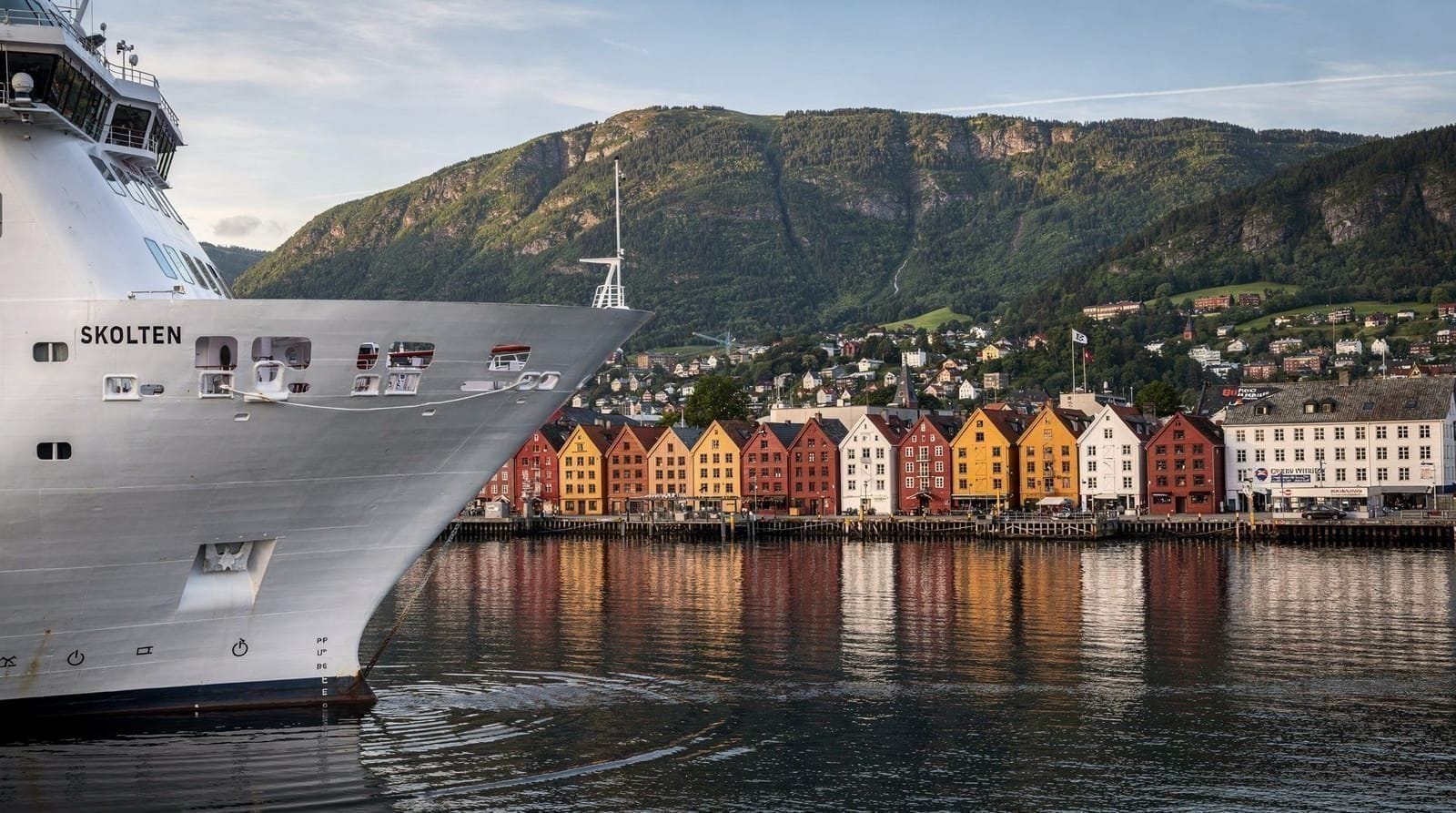
Bryggen is Bergen's row of colorful Hanseatic wooden warehouses on the north quay of Vågen harbor, listed as UNESCO World Heritage since 1979. The alleyways behind the frontages are free to walk. It is absolutely worth visiting — but time your arrival before 9 am or after 4 pm to avoid the cruise ship crowds that pack the site from 10 am to 3 pm in summer.
Bergen’s painted timber warehouses are among the most photographed sights in Scandinavia — and, on a July afternoon, among the most crowded. Bryggen has attracted Hanseatic League merchants since the 14th century and cruise ship passengers since the 1990s. Both groups arrived for the same reason: this is genuinely one of the most atmospheric medieval commercial sites in Northern Europe. Getting the most out of a visit is mostly a question of timing.
| Where | North quay of Vågen harbor, 12 min walk from Bergen station |
| Cost | Free to walk; museums NOK 80–130 each |
| Time needed | 30 min quick walk; 2–3 hours with museums |
| Getting there | On foot from Bryggen, Fish Market or the cruise pier |
| Best time | Before 9 am or after 4 pm to avoid cruise crowds |
What Bryggen actually is — and what it is not
The frontage you see in every Bergen photograph — a row of narrow gabled warehouses in red, ochre, and yellow timber — was rebuilt after the fire of 1955 that destroyed much of the medieval structure. The current buildings replicate medieval proportions but are not the original 14th-century construction.
What is genuinely old: the foundations and the network of narrow alleyways (schøtstuene passageways) behind the frontages. Excavations before the post-fire rebuild uncovered archaeological layers going back to around 1070 AD, including 14th-century harbor structures, Hanseatic guild artifacts, and everyday objects from the Norse trading settlement that predated the Hansa. The Bryggens Museum displays a large portion of these finds.
The Hanseatic League operated Bryggen as a closed German trading colony called the Kontor from around 1360 to 1754. German merchants lived in the warehouses year-round, were forbidden from marrying Norwegian women, and controlled the dried-fish trade that made Bergen wealthy. The power dynamic between the Hansa and Norwegian merchants shaped Bergen’s development for four centuries.
The alleyways — what to expect
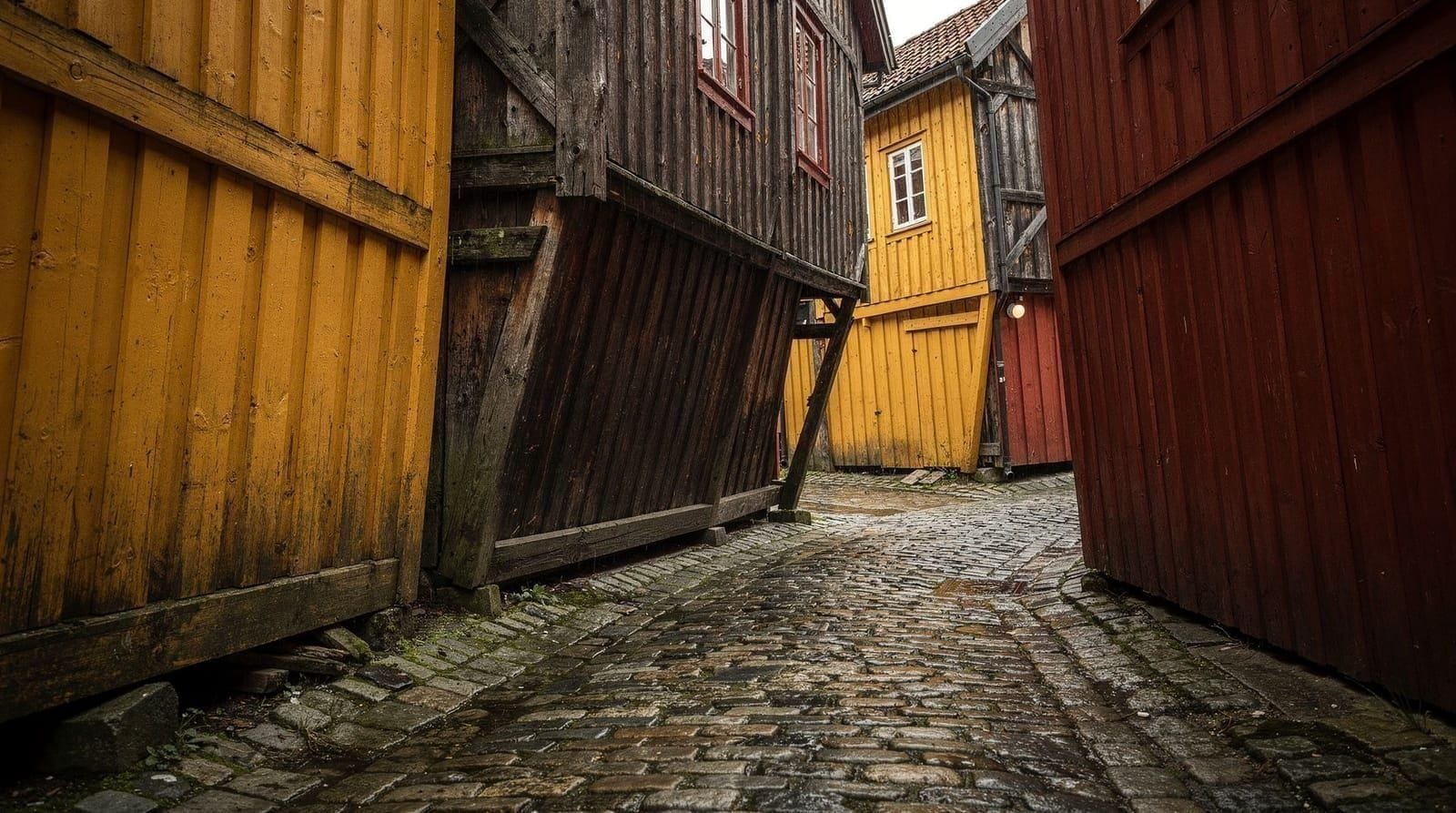
The alleys behind the frontage run perpendicular to the harbor, dividing the wharf into separate assembly yards (gårder). Each yard contains several warehouse buildings, craft workshops, and small businesses at ground level. Most are open to walk through freely during daylight hours.
What you will find: Norwegian craft shops (silver jewelry, knitwear, ceramics — quality varies widely), a few galleries, the Hanseatic Museum, the Theta Museum, amber and souvenir shops, and some small cafés.
The craft quality ranges from excellent (there are a handful of genuine Norwegian artisans working in the alleyways) to mass-produced tourist imports. Take time to look before buying — the best work is not always in the most prominent stalls.
The café options inside the alleyways are convenient but expensive even by Bergen standards. A coffee and a cinnamon bun at one of the small alley cafés: NOK 90–130. Better to eat at Mathallen Bergen and return with energy for the alleyways.
Bryggens Museum — the most informative stop
Bryggens Museum sits at the northern end of the Bryggen frontage and is operated by the University of Bergen. It holds the largest collection of medieval artifacts from the Bryggen excavations.
The permanent exhibition covers the archaeological finds chronologically: Norse settlement, Hanseatic trading practices, the runic inscriptions found on the site (Bergen has produced more medieval runic finds than anywhere else in Scandinavia), and the working life of the trading colony. The reconstructed Hanseatic Assembly Room (Schøtstuene) — a communal meeting hall — is one of the most atmospheric interiors in the city.
Entry: NOK 130 adult, free under 18, included with Bergen Card. Allow 60–90 minutes.
The Hanseatic Museum and Schøtstuene
A short walk from the main frontage, the Hanseatic Museum (Hanseatisk Museum) is housed in one of the original assembly buildings and shows how the German merchants actually lived. The interiors include sleeping quarters, communal heating arrangements (fireplaces were banned in the warehouses due to fire risk — hence why so many burned), and the hierarchical guild structure from apprentice to merchant.
Entry: NOK 130, included with Bergen Card. Combined tickets with Bryggens Museum are available.
The Theta Museum — Bergen’s wartime resistance story
The Theta Museum occupies a single room on the upper floor of one of the Bryggen buildings where a Norwegian resistance group operated during the German occupation (1940–1945). The group transmitted intelligence to London via radio. The room is tiny but the story is compelling — the museum is less visited than it deserves to be because it is hard to find (ask at the Bryggens Museum desk for directions).
Entry: NOK 80, not typically included in Bergen Card. Worth 30 minutes if you have an interest in Norwegian wartime history.
Best time to visit Bryggen
Dawn to 9 am: The best window for both photographs and a peaceful walk through the alleyways. The frontage in early morning light before tour groups arrive is the version of Bryggen that exists in actual Bergen residents’ memories of the place. The shops are closed, but the architecture and atmosphere are fully available.
9–10 am: Still manageable. The first cruise passengers reach Bryggen around 9:30 am after tendering in and taking the short walk from the cruise pier.
10 am–4 pm: Peak congestion in summer. The alleyways are passable but crowded; the frontage photo spots require patience. Bryggens Museum is less affected than the outdoor alleyways.
4–6 pm: The cruise passengers return to their ships; congestion drops significantly. This is a good time for a second pass through the alleyways.
September–May: Bryggen in the off-season is a different place — fewer visitors, quieter alleyways, and the possibility of seeing the buildings in snow (December–February) or autumn fog (October). Most shops remain open year-round. For the wider seasonal picture, see the best time to visit Bergen and Bergen in winter.
Rain is part of Bergen life, and it need not spoil a visit: the museums give you a dry way to spend the hours, and the wet timber facades photograph well. Our Bergen in the rain guide has more ideas for filling a grey day.
If you arrive by ship, the Bergen cruise port guide explains how to plan the walk to the wharf, and the one-day cruise stopover itinerary shows how Bryggen fits into a short call.
Bergen received 590,944 cruise passengers in 2024 across 328 ship arrivals. Since June 2022, the port caps daily arrivals at 4 ships and 8,000 passengers. Peak days in July can still see all 8,000 directed toward the same 400-meter frontage.
Photography at Bryggen
The standard shot — from the opposite (south) quay looking across Vågen harbor at the full frontage — requires a mid-harbor position that is most cleanly achieved from the east end of Torget (the square adjacent to the Fish Market) or from a boat on the water.
For the alleyway interiors, the best light enters from above in the late afternoon when the sun is at an angle that illuminates the corridor walls. High noon creates flat, overcast-like light even on sunny days due to the narrow shafts.
The north end of Bryggen, past Bryggens Museum where the cruise pier begins, gives a good angled view of the frontage without shooting directly into backlight.
Bryggen at night
Most visitors treat Bryggen as a daytime sight, which means the evening version is a genuine local secret. After the shops close (typically 6–7 pm) and the cruise passengers have returned to their ships, the frontage is lit softly against the dark harbor water, and the alleyways — empty of both crowds and commerce — take on a different character entirely: quiet, slightly eerie, and closer to how the site would have felt for centuries of merchants working after dark by lamplight.
In summer, the extended daylight (sunset around 10:15–10:30 pm in late June) means “evening” at Bryggen can still mean bright, warm light on the timber facades well past normal dinner hours — one of Bergen’s most distinctive characteristics for visitors from lower latitudes. In winter, by contrast, Bryggen is dark by mid-afternoon, and the frontage lit against the black harbor is a genuinely atmospheric, almost cinematic version of the site that few day-trippers ever see.
A short evening walk from the Fish Market north along Bryggen and back, timed for just after sunset, costs nothing and adds a completely different register to a visit that most people experience only in the crowded midday version.
Bryggen for first-time Bergen visitors — a suggested first hour
If Bryggen is your first stop in Bergen, a practical sequence gets you oriented quickly without spending the whole day: start at the Fish Market end and walk the full frontage north, glancing down each alley without committing to a full exploration. At the northern end, near the cruise pier, turn back into the alleyways and pick two or three that looked most interesting on the first pass — this avoids the common mistake of exhausting yourself in the first courtyard and rushing the rest.
Finish at Bryggens Museum if you have another hour, since the archaeological context makes the walk you have just done considerably more meaningful in retrospect. This whole sequence takes under 90 minutes and works as a natural lead-in to the Bergen city sightseeing route for the rest of the day.
Getting to Bryggen
Bryggen is at the north end of Vågen harbor, a 12-minute walk from Bergen’s central railway station (Jernbanestasjonen) via Kaigaten and the harbor promenade. From the Fish Market (Fisketorget): 5 minutes on foot north along the quay.
No tram or bus needed from the city center — it is all walkable. If you are still working out how to reach the centre in the first place, the getting around Bergen guide covers the options.
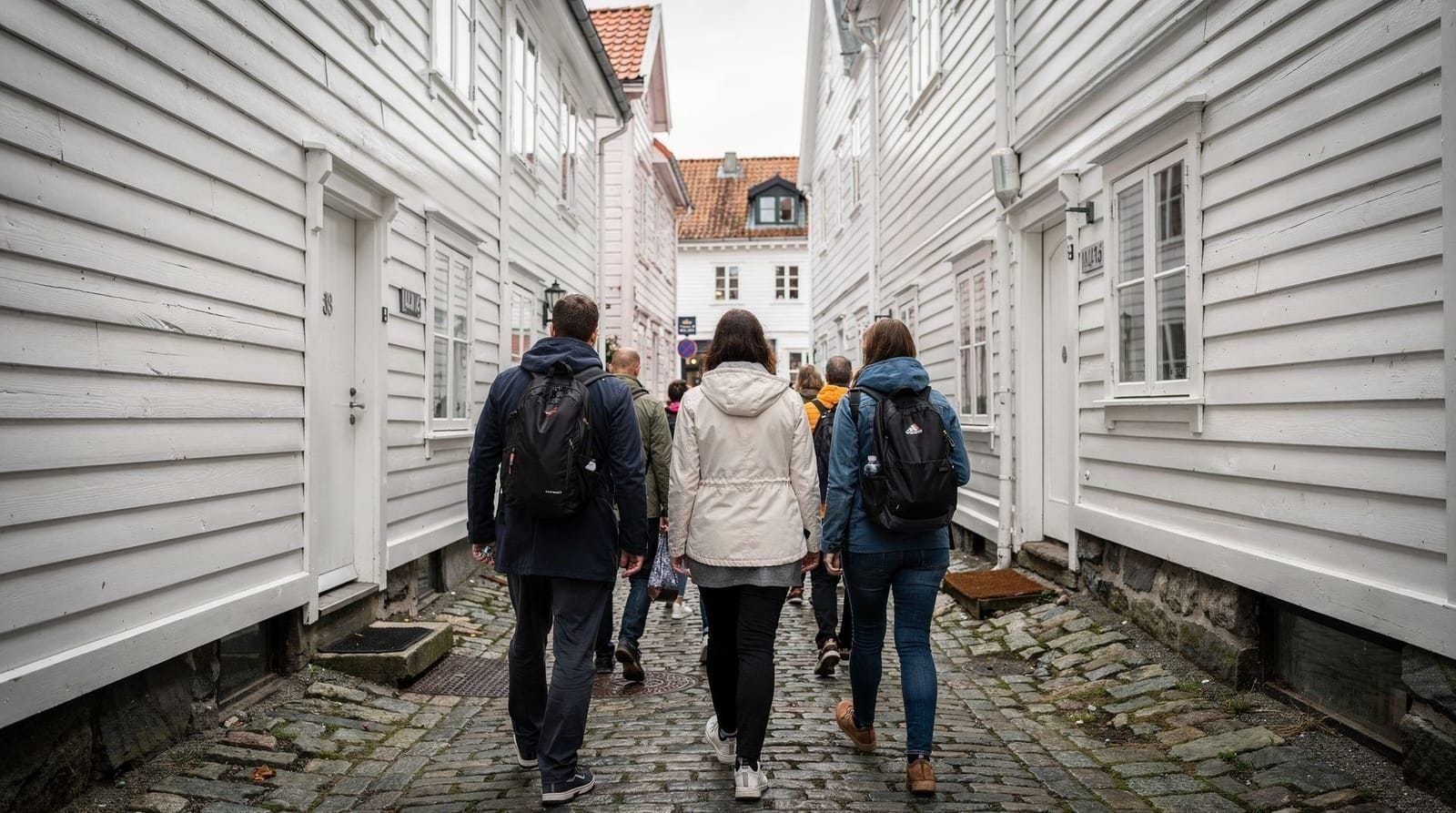
Bergen walking tour: past and presentA guided walking tour of Bryggen and the surrounding historic city adds genuine depth to what can otherwise be an untextured stroll through shops. Good guides explain the Hanseatic guild structure, point out architectural details that are easy to miss, and distinguish the reconstructed from the genuinely medieval. Allow 2 hours.
Bryggen’s surviving buildings date from after the 1702 fire, yet the plot boundaries beneath them are medieval, which is why the alleys are the oldest thing on the wharf: a Bergen Past and Present historical walking journey reads the site through those layers.
The fires of Bryggen — why rebuilding mattered
Bryggen burned catastrophically multiple times. The most significant fires occurred in 1198, 1248, 1413, 1476, and 1702. The 1702 fire destroyed most of the city of Bergen; the subsequent rebuild preserved the medieval street plan and alleyway structure even while replacing the structures. The 1955 fire — started in a nearby building — burned seven of the 58 remaining Bryggen structures before being contained.
Each fire was followed by rebuilding that broadly maintained the medieval layout because the property boundaries, the alleyway structure, and the relationship to the harbor were established by centuries of commercial use. The UNESCO inscription in 1979 recognized not just the surviving structures but the continuity of the urban form — Bryggen is the only remaining example of the Hanseatic League’s architectural and organizational layout in any Norwegian city.
Understanding the fire history changes how you look at Bryggen: you are walking through a site that has been repeatedly destroyed and rebuilt by people who valued the urban structure enough to maintain it across 800 years. The post-1955 reconstruction is not an anomaly but the latest in a long sequence.
The Hanseatic League — who they were and why it matters
The Hanseatic League (from Low German: Hanse, meaning “convoy” or “group”) was a commercial and defensive confederation of merchant guilds and market towns in Northern Europe, operational from the 14th to 17th century. At its peak, the Hansa controlled trade across the Baltic and North Seas, from London and Bruges in the west to Tallinn and Novgorod in the east.
Bergen’s Kontor (trading post) was one of four major Hanseatic offices outside Germany — the others being in London (the Steelyard), Bruges, and Novgorod. Bergen’s significance came from one commodity: dried cod (stockfish) from the Arctic waters of Lofoten and the Barents Sea. The Hansa controlled the distribution of this protein source to Catholic Europe’s market (where meat was forbidden on Fridays and during Lent — meaning roughly 150 days per year required alternatives). Bergen was the collection and processing point.
The German merchants who operated the Kontor lived in the Bryggen warehouses year-round. They were forbidden from marrying Norwegian women, from operating outside the Kontor, and from integrating into Bergen society. This was not mere prejudice — it was a commercial strategy to keep the German trading colony separate and prevent the integration that would redistribute wealth to Norwegian merchants.
When Bergen’s Norwegian merchants eventually broke the Hansa monopoly in 1754, it ended nearly 400 years of German commercial control over the city’s primary export. The event is remembered in Bergen with some pride; the Hanseatic Museum’s interpretation takes care to tell both the German merchant story and the Norwegian experience of operating under the Kontor’s control.
Bergen’s identity beyond Bryggen
Bryggen represents only one strand of Bergen’s historical identity — the commercial-maritime one. The city also developed as a medieval ecclesiastical center (Bergen was the seat of one of Norway’s most important bishoprics), as a royal capital (Håkon IV made Bergen Norway’s capital in the 13th century; Bergenhus Fortress dates from this period), and as a civic center that produced several of Norway’s most significant cultural figures: Edvard Grieg (composer), Ole Bull (violinist), and Ludvig Holberg (playwright, “the Molière of the North”) all came from Bergen.
This broader identity is accessible through the Bergen museums and the Bergen city sightseeing route — Bryggen alone gives the commercial history but not the full picture.
What to do after Bryggen
Bryggen is a natural starting point for a wider city sightseeing route. From the north end of Bryggen, Bergenhus Fortress is a 5-minute walk. From the south end, the Fish Market is a 5-minute walk, and Fløibanen lower station is a 3-minute walk behind the market.
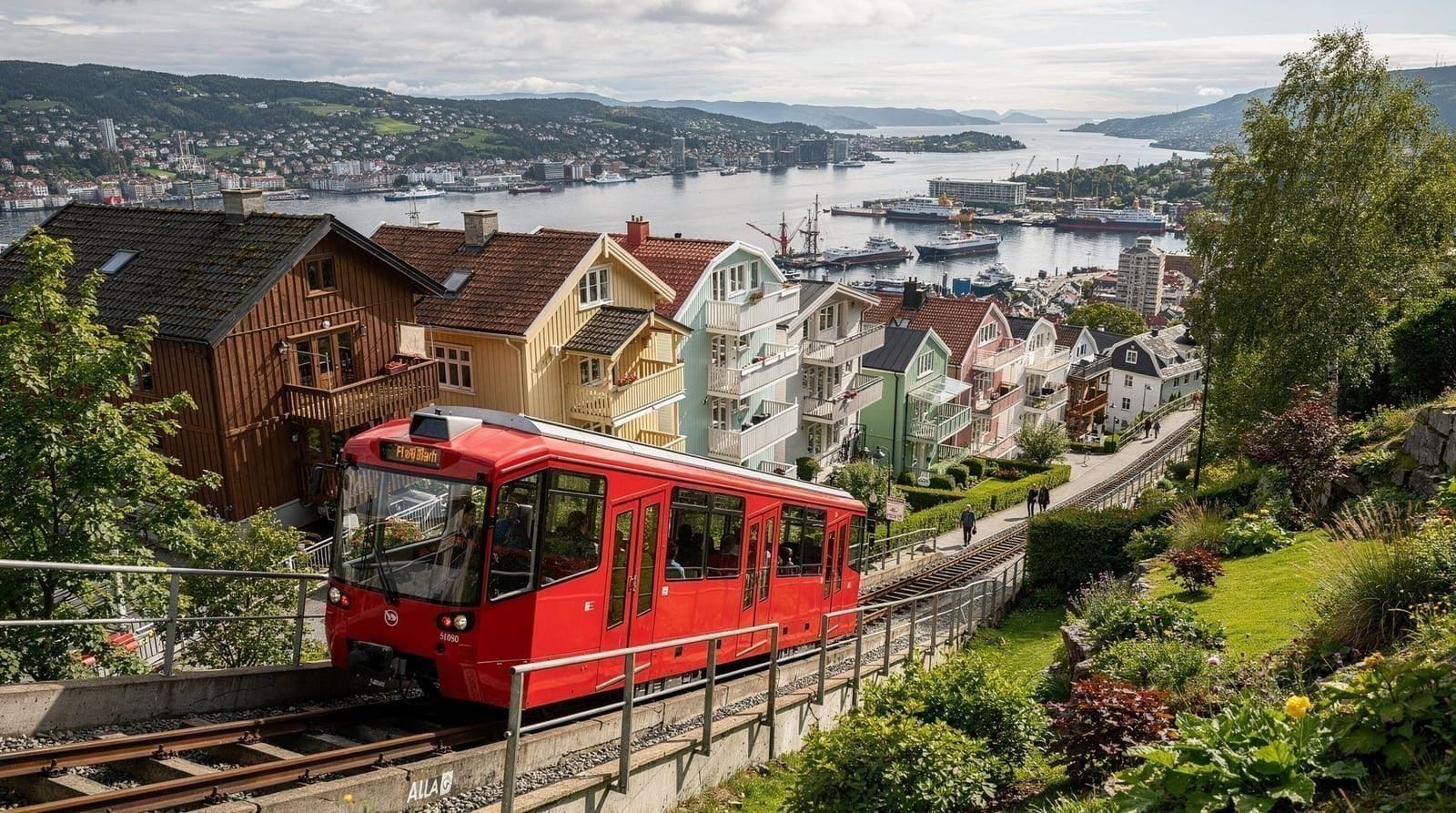
The Fløibanen funicular gives the best elevated view of Bryggen from above — the frontage is clearly visible from the summit of Mount Fløyen and is one of the primary reasons for taking the ride.
If Bryggen is one stop in a longer trip, the two-day Bergen itinerary and the first-timer guide show where it sits among the other highlights, and how many days in Bergen helps you decide how long to stay.
For culture beyond the Hanseatic story, the KODE art museums are a 10-minute walk south along the harbor.
For the complete food and restaurant picture around Bryggen, including which places are tourist-oriented and where locals actually eat, see the Bergen food and drink guide.
Shopping at Bryggen — the craft vs. tourist assessment
The alleyways at Bryggen contain both genuine Norwegian craft and mass-produced tourist goods, and the distinction is not always obvious. A practical guide:
Worth considering: Silver jewelry from Norwegian designers with Bergen workshop addresses — Bergen has a history of silversmithing that predates the Hanseatic period, and several contemporary craftspeople work in the Bryggen area. Hand-knit wool items from Norges Husflidslag-certified Norwegian producers (check the label; Norwegian law requires country-of-origin labeling). Local ceramics and glasswork from craftspeople working on-site.
Avoid: “Norwegian” knitwear from production facilities in other countries (the label will say “made in” somewhere other than Norway); troll figurines and Viking-themed items at Bryggen prices (identical items available cheaper in Bergen’s main shopping street Torgallmenningen); amber jewelry described as “Norwegian” (Norway does not produce amber; it comes from Baltic deposits).
The quality test: Genuine Norwegian craft typically comes with a card from the maker, a specific location, and a price that reflects real labor costs. A hand-knit Bergen sweater costs NOK 800–1,500; a machine-knit import labeled “Norway” costs NOK 200–400. If the price seems too low for what the item claims to be, it probably is.
Eating around Bryggen without overpaying
Bryggen sits inside Bergen’s most tourist-dense square kilometer, and restaurant pricing reflects that. A rough guide to what you are actually paying for:
| Option | Price range | Verdict |
|---|---|---|
| Alley café coffee + bun | NOK 90–130 | Convenient but a premium; fine for a quick break |
| Enhjørningen (seafood) | NOK 300–500/main | Genuine quality, tourist-oriented pricing |
| Bryggeloftet & Stuene | NOK 250–400/main | Historic building (since 1910), solid mid-range |
| Mathallen Bergen (food hall) | NOK 120–250/dish | Better value, 5–8 min walk from Bryggen |
| Fish Market outdoor stalls | NOK 150–350 | Convenient but among the most expensive per gram in the city |
A guided culinary walk is a reasonable way to sidestep the guesswork — a good guide takes you to vetted stops rather than the highest-visibility ones directly on the frontage.
Bergen culinary and food culture walking tourBryggen in the context of Bergen’s whole city
Bryggen is frequently treated as Bergen’s only significant sight — this is a misreading of the city. The UNESCO-listed wharf is important and beautiful, but it represents the commercial-maritime strand of Bergen’s identity, not the whole.
The full Bergen picture includes: the fortress and royal history at Bergenhus, the Norwegian Romantic art at KODE, the medieval medical history at the Leprosy Museum, and the musical history at Grieg’s Troldhaugen. Bryggen is the place to start; see the Bergen city sightseeing guide for a complete overview of how these sites connect.
The relationship between Bryggen and the Bergen fish market immediately to the south is historically continuous — the fish market has occupied the adjacent square (Torget) for 700 years as the retail complement to the Hanseatic wholesale trade. Walking from Bryggen south to the fish market and then uphill to the Fløibanen station is a 15-minute sequence that covers Bergen’s three most-visited tourist sites and makes geographical sense as an entry sequence to the city.
Frequently asked questions about Bryggen Hanseatic wharf
Is Bryggen free to visit?
The alleyways, courtyards, and frontage are free to walk through. Bryggens Museum (NOK 130), the Hanseatic Museum (NOK 130), and the Theta Museum (NOK 80) each charge entry. Bergen Card covers the main museums.
Was Bryggen built by the Hanseatic League?
The original structures date from Norse settlement predating the Hansa, but the Hanseatic League took over and rebuilt the site extensively from around 1360. The buildings visible today are post-1955 reconstructions that follow medieval proportions. The foundations and underground layers are genuinely medieval.
How long should I spend at Bryggen?
A quick walk through the alleyways takes 30 minutes. Add Bryggens Museum and allow 2 hours total. With the Hanseatic Museum and a longer alleyway exploration: 3 hours.
Can you enter the Bryggen buildings?
The ground floors of most buildings in the alleyways are accessible — they contain shops and small businesses. Upper floors are private residences or offices. The interiors of Bryggens Museum and the Hanseatic Museum are the best way to see the historic interior spaces.
How does Bryggen compare to similar historic warehouse districts?
Bryggen is most often compared to Nyhavn in Copenhagen, but the Bergen site is historically more significant (UNESCO vs. no listing for Nyhavn) and the medieval alleyway network has no Scandinavian equivalent. The scale is smaller than Amsterdam’s canal warehouse district, but the concentration of medieval commercial architecture is unique in Norway.
What is the best restaurant near Bryggen?
For seafood, Enhjørningen (The Unicorn) on the Bryggen quay is a well-regarded Bergen institution (main courses NOK 300–500). For something more casual, the Bryggeloftet & Stuene at the south end of Bryggen has been operating in the same building since 1910 (mains NOK 250–400). Both are tourist-oriented but maintain decent quality.
Is Bryggen accessible for visitors with limited mobility?
The harbor-side frontage and the street level of the alleyways are accessible on foot, but the interior alleyways are uneven cobblestone and several passageways require small steps. Bryggens Museum has ground-floor access; upper levels via stairs.
Why does Bryggen look so colorful?
The distinctive red, ochre, yellow, and grey painted timber facades follow the traditional color scheme of the Hanseatic period, when buildings were painted to indicate the merchant guild they belonged to. The post-1955 reconstructions maintain this palette as part of the UNESCO heritage requirements.
Top experiences
Bookable activities with verified prices and instant confirmation on GetYourGuide.