Bergen museums and culture — KODE, Hanseatic, Leprosy, and Gamle Bergen explained
Bergen: 24, 48, 72 or 96-Hour Bergen Card
Which Bergen museums are worth visiting?
KODE (four buildings, NOK 180 combined, best Munch collection outside Oslo) and Bryggens Museum (NOK 130, medieval archaeology) are the priorities. The Leprosy Museum is small but historically significant and often overlooked. Gamle Bergen open-air museum suits families. Bergen Card covers most admissions.
Bergen is a cultural city that does not always get credit for the depth of its museum holdings. The KODE art museums are legitimate world-class institutions by any standard — not “good for Norway” but genuinely impressive in international terms. Add to that the Hanseatic and archaeological collections at Bryggens Museum, the unusual Leprosy Museum, the Edvard Grieg sites, and the open-air Gamle Bergen, and you have enough quality indoor programming to fill three full days.
| Where | KODE around the lake; Bryggen museums at the wharf |
| Cost | Around NOK 180–500 depending on how many museums |
| Time needed | Half-day per major site; 2–3 days for the full circuit |
| Getting there | Walkable — all sites within 15 min of Bryggen |
| Best time | Any season; museums are the strongest rain-day option |
This guide covers each museum honestly: what the collections actually contain, how long to allow, whether the Bergen Card makes financial sense, and what to skip if time is short.
KODE art museums — Bergen’s most underrated asset
KODE runs four buildings across Rasmus Meyers Allé and Nordahl Brunsgate, all within walking distance of each other along the lake edge south of the city center. The combined admission ticket (NOK 180 adult, free under 18) covers all four buildings and is valid for multiple visits on the same day.
KODE 1 houses the decorative arts collection: Norwegian and European furniture, silver, ceramics, glass, and applied arts from the 17th century to the 20th. Strong on Art Nouveau and Bergen’s own historical craft traditions. Visually rich; often overlooked.
KODE 2 is the primary building for Norwegian art history. The permanent collection includes major works by Johan Christian Dahl (the father of Norwegian landscape painting), Harriet Backer, and Nikolai Astrup. The Rasmus Meyer Collection — assembled by Bergen businessman Rasmus Meyer before 1916 and donated to the city — is displayed here and represents one of the finest private Norwegian art collections ever assembled.
KODE 3 focuses on international art from the 17th century onward, including Dutch and Flemish masters. Smaller and more specialized; most visitors spend less time here.
KODE 4 (Lysverket): The most visited building, housing the Munch Collection (the world’s largest collection of works by Edvard Munch outside Oslo’s Munch Museum, approximately 50 works including drawings, paintings, and prints) and a substantial Picasso holding (7 paintings donated by Picasso himself to the city of Bergen in 1962, after Bergen supported a peace congress Picasso endorsed). The ground-floor Lysverket restaurant is among Bergen’s best. The architecture of the building — a 1930s power station converted with care — is impressive in its own right.
How long to allow: KODE 2 and KODE 4 require 2–3 hours minimum; all four buildings in a single day is ambitious and requires 5–6 hours for a thoughtful visit. Prioritize KODE 2 and KODE 4 if time is short.
Bergen Card — includes KODE admissionBryggens Museum — medieval Bergen under glass
Bryggens Museum at the north end of the Bryggen frontage is managed by the University Museum of Bergen (BSMU). It was built directly over the excavation site uncovered after the 1955 fire — the museum floor in places is the 12th-century ground level, and you walk through the archaeology.
The permanent exhibition covers: the Norse settlement at Bryggen predating the Hanseatic League; the German Kontor’s operating structure and social organization; runic inscriptions (Bergen has produced more findable medieval runic messages than anywhere else in Scandinavia, including carved wooden rune sticks used as practical notes); and the material culture of medieval trade — weights, tools, preserved foodstuffs, clothing fragments.
The Schøtstuene — the reconstructed Hanseatic Assembly Room — is housed in the original 18th-century building adjacent to the museum and gives the best sense of how the German merchants actually gathered for business, meals, and fraternal functions within the closed Kontor community.
Entry: NOK 130 adult, free under 18, included in Bergen Card. Allow 90 minutes minimum. Pair it with a walk through the Bryggen alleyways themselves — the museum gives context that makes the wharf outside far more legible.
Hanseatic Museum (Hanseatisk Museum)
The Hanseatic Museum is housed in one of the few surviving original Bryggen buildings from the 1700s and focuses on the daily life and social structure of the German Hanseatic merchants who ran the Bryggen Kontor from 1360 to 1754. The interior includes sleeping quarters (stacked bunks in unheated rooms, communal sleeping between apprentices for warmth), the council room, the kitchen with its strict fire-prohibition rules, and period artifacts.
This museum is more intimate and experiential than Bryggens Museum — it shows you what it felt like to be a young German apprentice in this place, not just what the historical facts were.
Entry: NOK 130, included in Bergen Card. Allow 60–75 minutes.
The Leprosy Museum (Lepramuseet) — Bergen’s hidden gem
Bergen was the center of European leprosy research in the 19th century. Gerhard Henrik Armauer Hansen, a Bergen physician, identified the Mycobacterium leprae bacterium in 1873 — the first time a specific bacterium was identified as the cause of a specific disease. His discovery in Bergen effectively launched the germ theory of infectious disease as a field.
The Leprosy Museum (St. Jørgens Hospital) is housed in the original leprosy hospital that operated on this site from the 1400s to 1946. The wooden hospital complex, surrounded by a walled garden, is one of the best-preserved medieval hospital sites in Scandinavia. The exhibition covers Hansen’s research, the lives of patients (many of whom lived here for decades), and the global significance of the Bergen leprosy studies.
This museum is less visited than the main Bergen tourist circuit and is all the better for it. The combination of a powerful historical story, a well-preserved complex, and a genuine contribution to medical science makes it one of Bergen’s most intelligent museum experiences.
Hansen’s discovery had global consequences beyond Bergen: the bacterium he identified is still called Mycobacterium leprae, and the disease itself is medically referred to as Hansen’s disease in his honor — a naming convention adopted specifically to reduce the historical stigma attached to the word “leprosy.” Understanding that Bergen, a relatively small Atlantic port city, produced research with this level of lasting global medical impact reframes the museum from a curiosity into one of the city’s most substantive cultural credentials.
Location: Kong Oscars gate 59, a 10-minute walk from Bryggen.
Entry: NOK 110 adult, included in Bergen Card.
Allow: 60–75 minutes.
Gamle Bergen (Old Bergen Museum) — open-air time capsule
Gamle Bergen is an open-air folk museum in the Sandviken district north of the city center, approximately 4 km from Bryggen (accessible by bus, 15–20 minutes). The museum preserves approximately 55 wooden buildings from 17th to 20th century Bergen, relocated from various city sites and reassembled into a coherent historical neighborhood.
Walking through Gamle Bergen feels like a reconstructed 19th-century Bergen street — bakeries, shops, homes, a doctor’s office, a photographer’s studio, all with costumed guides in summer (May–September) who explain daily life in period character. In winter (October–April), the buildings are accessible without guides and the atmosphere is entirely different — a deserted historical village in the grey Bergen mist.
Best for: Families with children (the costumed guides engage kids well); visitors with Norwegian heritage who want to understand ordinary life as opposed to merchant history; anyone interested in vernacular architecture.
Entry: NOK 150 adult, NOK 75 child, included in Bergen Card. Allow 2–3 hours for the full open-air circuit.
Bergenhus Fortress — free and often rushed past
Bergenhus Fortress at the north end of Bryggen is one of Norway’s best-preserved medieval stone fortresses. The main structures are:
Håkon’s Hall (Håkonshallen): Built by King Håkon Håkonsson for his son’s wedding in 1261, this Gothic great hall is the best-preserved secular Gothic building in Norway. Entry NOK 100 (Bergen Card); guided tours available.
Rosenkrantz Tower: A Renaissance tower added to the medieval fortress by Governor Erik Rosenkrantz in the 1560s. Entry NOK 100 (Bergen Card); the tower interior is a fascinating multi-story palimpsest of different building phases.
The fortress grounds are free to walk and provide excellent harbor views. Most visitors walk directly past Bergenhus without stopping — allocate 90 minutes if you want to go inside both structures.
Bergen Card — museum bundle value
The Bergen Card (24h NOK 400 / 48h NOK 500 / 72h NOK 600) includes: KODE all four buildings (NOK 180 value), Bryggens Museum (NOK 130), Hanseatic Museum (NOK 130), Leprosy Museum (NOK 110), Bergenhus Fortress buildings (NOK 200 value), Gamle Bergen (NOK 150), Fløibanen 50% off, and Aquarium (NOK 380).
If you visit KODE, Bryggens Museum, and the Fløibanen funicular in a single day, the 24h card pays for itself at NOK 420 in savings vs. NOK 400 card cost. Add the Hanseatic Museum or Leprosy Museum and the saving grows. Calculate against your specific plans.
Planning a culture-focused Bergen trip
For visitors whose primary interest is Bergen’s cultural institutions, a suggested framework:
Day 1 (morning): Bryggens Museum + Hanseatic Museum + Theta Museum
All three sites are in the Bryggen area. Start at Bryggens Museum (opens 9 am) and work through the archaeological history. Walk to the Hanseatic Museum for the living-conditions exhibition. End with the Theta Museum if time allows (confirm current opening hours before visiting — it has had irregular hours). Total: 3–4 hours.
Day 1 (afternoon): KODE 2 and KODE 4
Walk south to Rasmus Meyers Allé (10 minutes from Bryggen). KODE 2 first for the Norwegian art history context, then KODE 4 for Munch and Picasso. Allow 2–3 hours minimum; the quality of the collections justifies longer.
Day 2 (morning): Leprosy Museum + Bergenhus Fortress
Both are on the west side of the city center. Leprosy Museum at Kong Oscars gate 59 (opens 10 am in summer). Bergenhus Fortress 5 minutes further west. Allow 30 minutes for the grounds, 45 minutes for Håkon’s Hall and Rosenkrantz Tower.
Day 2 (afternoon): Fløibanen + optional Troldhaugen
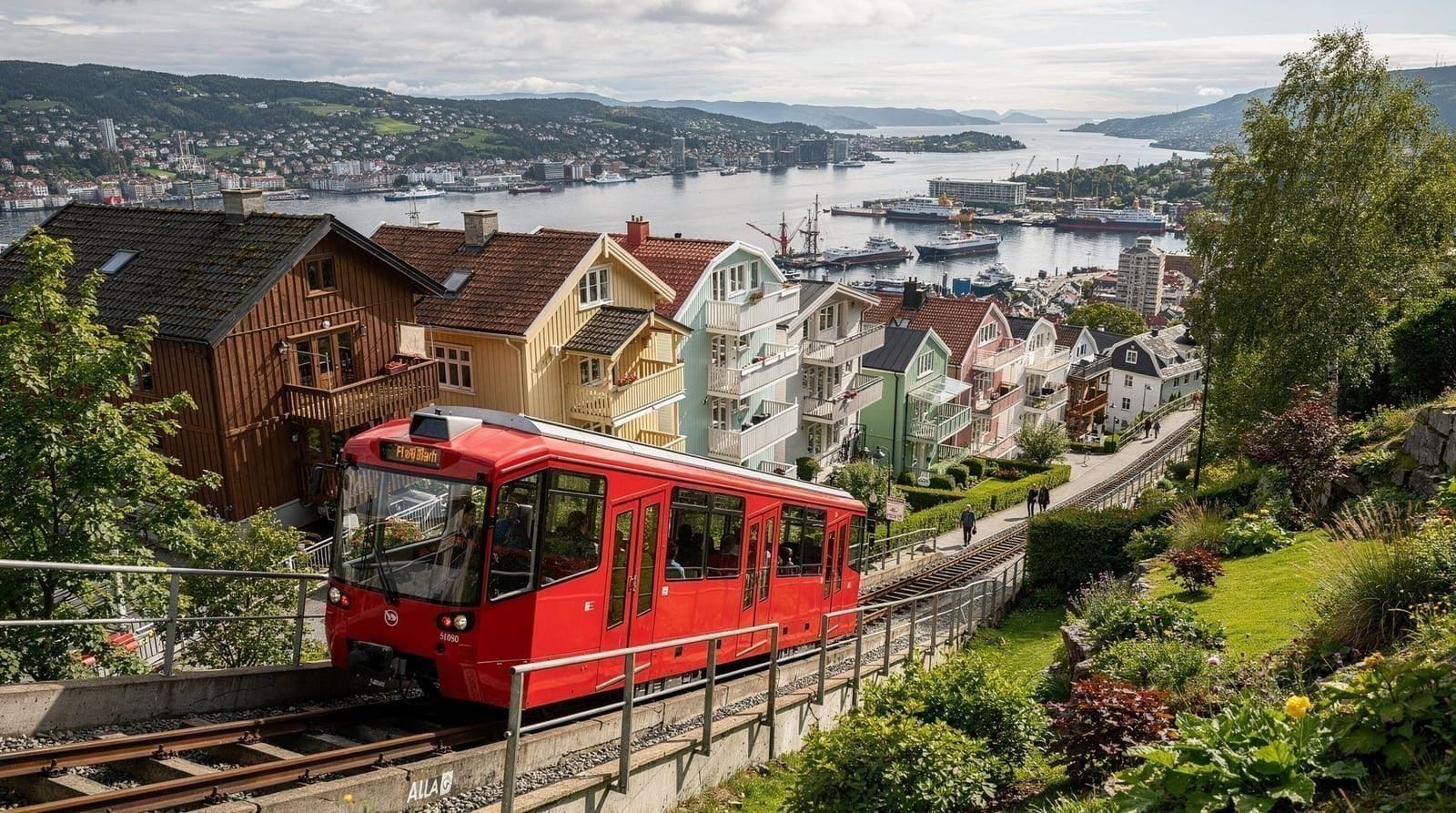
Fløibanen for the elevated city overview after two days at ground level. See our Fløibanen funicular guide for booking details. If time permits, a Troldhaugen visit by afternoon bus (30 minutes each way) completes the cultural circuit.
Optional Day 3 addition: Gamle Bergen
The open-air museum in Sandviken (bus from city center, 15–20 minutes) fills a half-day and is particularly worthwhile in summer when the costumed guide program operates.
This framework covers Bergen’s significant cultural institutions without overlap or backtracking, and uses the Bergen Card efficiently across two days.
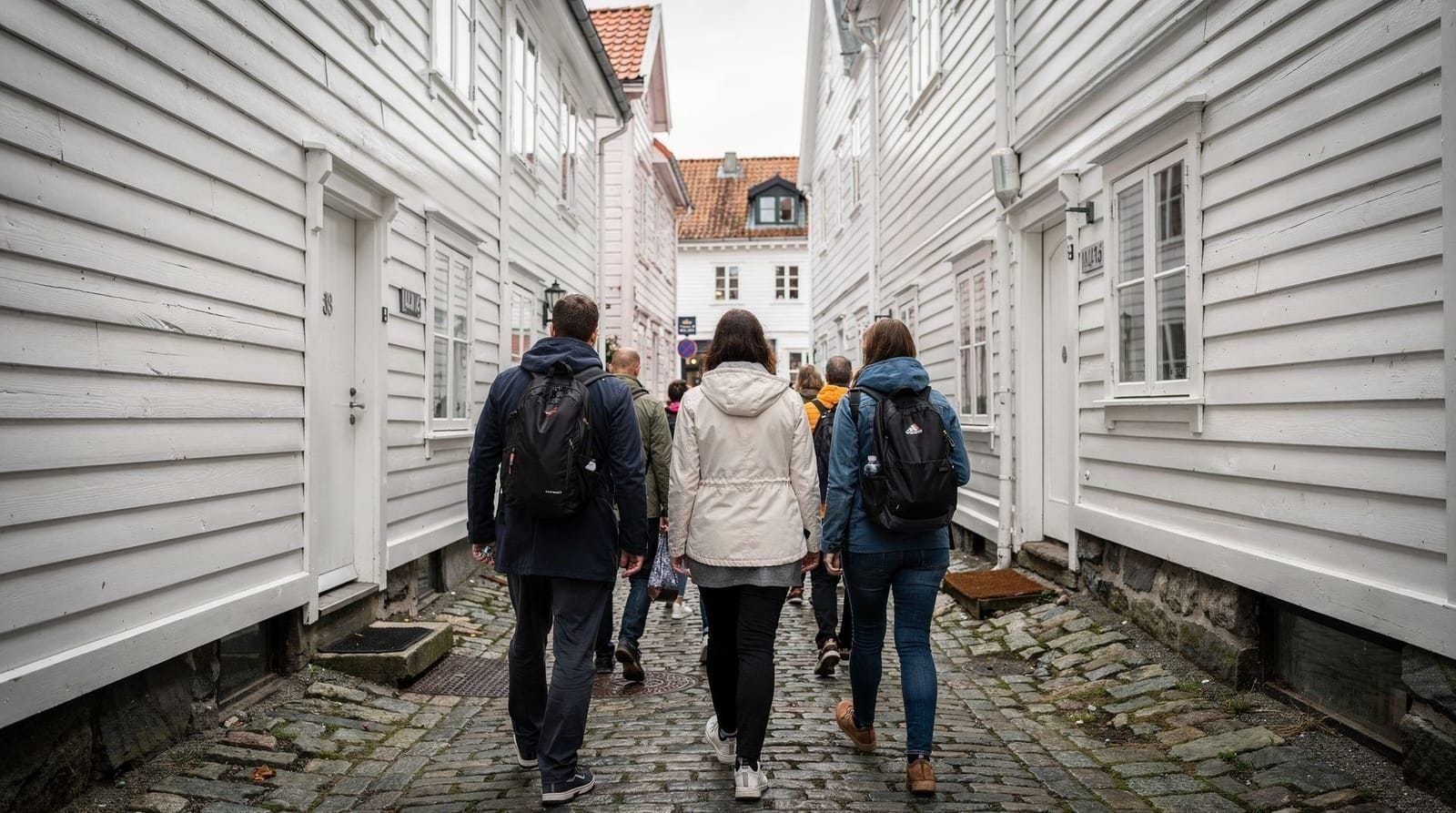
If you would rather have the history explained before you walk into the exhibitions, a guided walk through Bergen’s past and present is a good way to start day one: the stories you hear on the street make the Bryggen museums much easier to read afterwards. Visitors with a little more time can fold the museum days into the two-day Bergen itinerary, which already sequences the main sights around them.
Cultural institutions in Bergen beyond the museums
Bergen University (UiB): The university’s main campus on Nygårdshøyden has several small free museums including the Natural History Museum and the University Museum’s geological collections. These are specialist rather than general-interest venues but worth knowing if you have specific scientific or natural history interests.
National Stage (Den Nationale Scene): Bergen’s main theater on Engen has been in continuous operation since 1850. Primarily Norwegian-language productions. Not typically on tourist itineraries but relevant for visitors who read Norwegian or are interested in Scandinavian theater.
Bergen Art Museum (BSMU) permanent collections: Beyond KODE, the Bergen University Museum holds significant archaeological and ethnographic collections that are accessible to visitors. Primarily of specialist interest; KODE’s art collections are the more accessible general-interest option.
For more on Bergen’s complete sightseeing picture beyond museums, see the Bergen city sightseeing guide. If your museum day falls on a wet one, our Bergen in the rain guide covers how to sequence indoor sights for maximum comfort.
Frequently asked questions about Bergen museums and culture
Which single Bergen museum is most worth visiting?
KODE 4 (Lysverket building) for the Munch collection and Picasso works — it is genuinely world-class and frequently surprises visitors who were not expecting this level of collection in a Norwegian city. Bryggens Museum is the most relevant to understanding Bergen specifically.
Is the Bergen Card worth buying for museums?
For a 2-day visit with serious museum plans (KODE + Bryggens Museum + Leprosy + Fløibanen): yes, the 48h card pays for itself. For a single half-day of museum visiting: calculate your planned admissions first.
Are Bergen museums open year-round?
KODE operates year-round with slightly reduced winter hours. Bryggens Museum and Hanseatic Museum are year-round. Gamle Bergen’s guided program runs May–September; the open-air circuit is accessible year-round. The Leprosy Museum is open May–September with reduced winter hours.
How do Bergen’s museums compare to Oslo?
Oslo has larger institutions (National Museum of Norway, Munch Museum, Vigeland Park). Bergen is more intimate — smaller collections but high quality, particularly KODE. For a combined Norway trip, Bergen’s museums complement rather than duplicate Oslo’s.
Is there a combined ticket for all Bergen museums?
The Bergen Card is the closest thing to a combined ticket. Individual museum combination tickets exist for some pairs (Bryggens Museum + Hanseatic Museum is a common combo). KODE’s single ticket covers all four of their own buildings.
What are Bergen museum opening hours?
KODE: typically 11 am–5 pm daily (summer), 11 am–4 pm or closed Monday (winter). Bryggens Museum: 9 am–5 pm daily in summer. Specific hours vary; check individual museum websites. The Bergen Card app lists current hours.
Is the Leprosy Museum appropriate for children?
Yes, though the content requires context for younger children. The exhibition is not graphic; it focuses on the historical and scientific story. The hospital building itself is fascinating architecturally. Recommended from age 10 upward.
Can I photograph inside KODE?
Non-flash photography for personal use is permitted in the permanent collections. Some temporary exhibitions restrict photography; signs are clearly posted.
Which Bergen museums are best for a rainy day?
All of them, since every museum covered in this guide operates indoors year-round. KODE and Bryggens Museum are the strongest single choices if you only have time for one.
Can I visit Bergen’s museums on a cruise stop?
Yes, if your port stop is 6+ hours. KODE 2 and KODE 4 together, or Bryggens Museum plus the Hanseatic Museum, both fit within a half-day. See the Bergen cruise port guide for full itineraries.
KODE’s Norwegian art — what you are looking at
For visitors unfamiliar with Norwegian art history, the KODE 2 collection can feel rewarding but opaque without context. A few orienting points:
Johan Christian Dahl (1788–1857): Born in Bergen; trained in Copenhagen and Dresden. Dahl was the first Norwegian artist to take Norwegian landscape as a serious subject rather than treating it as a backdrop for classical subjects. His large paintings of the Norwegian west coast, mountain valleys, and waterfalls established a vocabulary for depicting Norwegian landscape that influenced everything that followed. His work at KODE 2 includes the famous “View of Stalheim” (1842), a panorama of the Nærøyfjord valley that visitors to Western Norway will recognize immediately.
Harriet Backer (1845–1932): One of Norway’s finest Impressionist painters and a painter of domestic interiors — lit rooms, figures at tables, women sewing — of unusual psychological depth. Her work in KODE 2 represents the generation that took Dahl’s landscape focus and turned it inward.
Nikolai Astrup (1880–1928): From Jølster in Western Norway; a regional master whose stylized depictions of West Norwegian farm landscapes, birch trees, and the Jølster valley have become among the most recognizable images in Norwegian visual culture. His work is increasingly appreciated internationally; KODE 2 has a significant Astrup holding.
The Rasmus Meyer Collection: This private collection, assembled in Bergen by businessman Rasmus Meyer (1858–1916) and donated to the city on his death, is one of the finest collections of Norwegian 19th and early 20th century art assembled by any private buyer. Meyer was a systematic collector who specifically focused on living Norwegian artists of his time — the result is a comprehensive cross-section of Norwegian Realism, Impressionism, and Symbolism that no single museum could assemble from scratch today.
Bergen’s outdoor cultural calendar
Bergen’s cultural life is not confined to museums. Several annual events make the city a destination for cultural visitors:
Bergen International Festival (Festspillene i Bergen): Held each May–June, typically lasting 10–12 days, the festival covers classical music, opera, jazz, theater, and visual arts. Performances take place at Grieghallen, Troldhaugen, Ole Bulls plass, and various Bergen churches and cultural spaces. This is Western Norway’s largest cultural event and one of Scandinavia’s most established festivals.
Nattjazz: Bergen’s jazz festival, held in late May, is one of Scandinavia’s oldest jazz festivals (since 1972). Primarily at USF Verftet (a converted factory on the harbor) with smaller venues throughout the city.
International Organ Festival: Bergen’s cathedral and churches host annual organ concerts. Not a mass-market event but relevant for visitors with an interest in sacred music and Bergen’s ecclesiastical heritage.
Bergen cathedral (Domkirken): Bergen’s main cathedral on Domkirkegaten is open to visitors and worth 20–30 minutes for the interior architecture. Free entry outside service times. The cathedral dates from the 12th century in its foundations, with the current structure primarily from the 17th–18th century after multiple fires. The rose window is the most distinctive feature.
USF Verftet: A former sardine cannery on the harbor south of the city center, now a converted cultural venue hosting concerts, exhibitions, and the Nattjazz festival. Worth knowing about even outside festival dates, as it regularly hosts smaller exhibitions and events not on the main tourist radar. Check its program if your visit overlaps with any listed dates — it is a genuinely different cultural space from the historic-building-heavy main museum circuit.
Bergenhus Fortress in depth
Bergenhus Fortress deserves more time than most visitors give it. Beyond the two main buildings (Håkon’s Hall and Rosenkrantz Tower), the fortress grounds contain:
The Munkeliv Monastery ruins: Medieval monastery foundations visible at the west end of the fortress grounds. Not well-signed; look for low stone wall remnants.
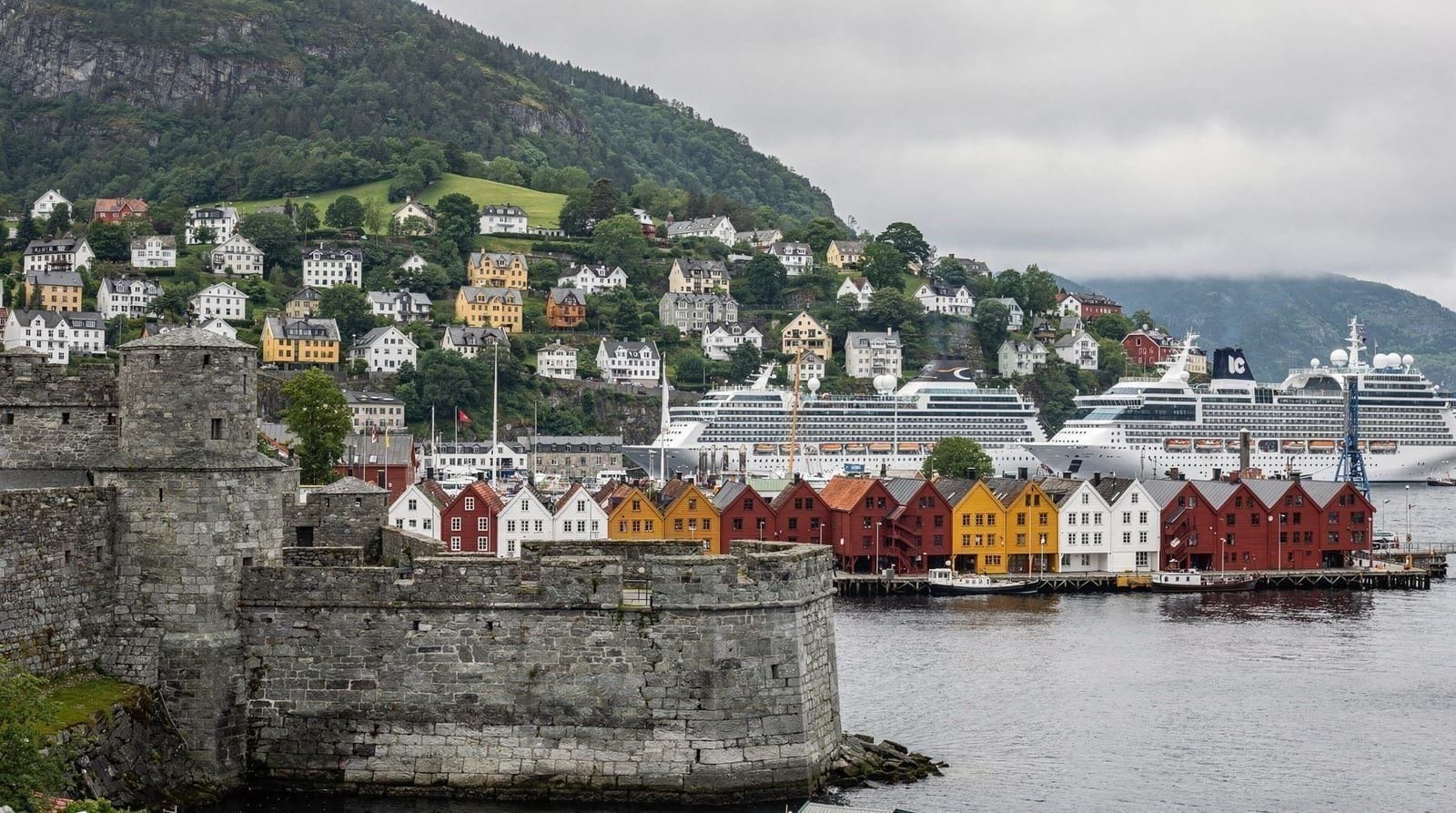
The harbor view from Bergenhus pier: Looking back at Bryggen from the fortress pier, with the harbor entrance ahead and the city behind, provides the most complete visual sense of Bergen’s medieval geography — the fortress at the harbor mouth, the trading wharf running along the north quay, the city rising on the hillside behind.
The 17th-century residential buildings: Several period buildings within the fortress grounds now serve as military museum spaces and administrative offices, but the ensemble of stone defensive walls, period buildings, and open grounds makes the complex more like a small walled town than a single attraction.
Bergenhus was Bergen’s primary administrative center through the Middle Ages. Understanding its relationship to Bryggen (the commercial zone) and the cathedral (the ecclesiastical zone) gives Bergen’s medieval geography a three-part structure that explains much of the city’s subsequent development. Walking all three in sequence — fortress, cathedral, wharf — in under an hour is one of the more efficient ways to grasp Bergen’s medieval layout without a guided tour.
The Bergen Philharmonic and live music
The Bergen Philharmonic Orchestra (founded 1765, making it one of the world’s oldest orchestras) performs year-round at Grieghallen, Bergen’s main concert hall. The orchestra’s connection to Grieg is central to its identity, but the programming is broadly symphonic — not exclusively Norwegian.
Grieghallen (Lars Hilles gate 3, adjacent to Lille Lungegårdsvannet) has a concert series from September through May. Tickets range from NOK 200 to NOK 650 depending on program and seating. Booking at harmonien.no. Attending a Bergen Philharmonic performance while visiting Bergen is a genuinely worthwhile cultural experience that most visitors do not plan for because it requires advance booking — something to consider if your dates overlap with the concert season.
Museums for a rainy or off-season day
New to the city? Our Bergen first-timer guide puts the museums in context with the rest of the trip, and the Bergen destination page gives the wider overview.
Bergen’s museum circuit is at its best precisely when the weather is not cooperating. Every major museum covered above operates year-round, and none depends on clear skies or calm seas the way a fjord day trip or a Fløyen summit view does. If you are visiting outside the May–September peak, or your trip coincides with one of Bergen’s frequent wet spells, treat the museum circuit as your primary daytime activity rather than a fallback — KODE, Bryggens Museum, the Hanseatic Museum and the Leprosy Museum together comfortably fill two full days regardless of what the sky is doing. For the seasonal picture of what else changes across the year, see our Bergen in winter guide.
Combining museums with a cruise stop
Cruise passengers with a full 8-hour port day have enough time to fit a genuine museum visit alongside Bryggen and the Fish Market — KODE 2 and KODE 4 together, or Bryggens Museum plus the Hanseatic Museum, both fit inside a half-day without rushing. A 4-hour stop is too tight for anything beyond a quick pass through Bryggens Museum. See the Bergen cruise port guide for full port-stop itineraries that build museums in properly, or the one-day cruise stopover itinerary for a ready-made order of stops. Short on time, a guided city walk on foot can cover the wharf and old town while you save your museum minutes for one or two big names.
When you need a break between galleries, the Bergen food and drink guide and the Bergen travel budget guide help you plan where to eat and how to keep admissions in proportion to the rest of your spending.
Top experiences
Bookable activities with verified prices and instant confirmation on GetYourGuide.