Lysefjord
Lysefjord: Preikestolen (Pulpit Rock), Kjeragbolten, and fjord cruises from Stavanger. Honest hiking guide with access routes from Bergen.
Stavanger: Preikestolen (Pulpit Rock) Guided Hike
Quick facts
- Distance from Bergen
- ~210 km to Stavanger; ~4–5 h by express boat or 3 h by car
- Preikestolen hike
- 8 km round trip, 500 m elevation, ~4 hours
- Kjeragbolten hike
- 10 km round trip, ~800 m elevation, 5–6 hours
- Lysefjord cruise (Stavanger)
- ~NOK 500–700 adult (2–3 h)
- Preikestolen parking
- NOK 250/day
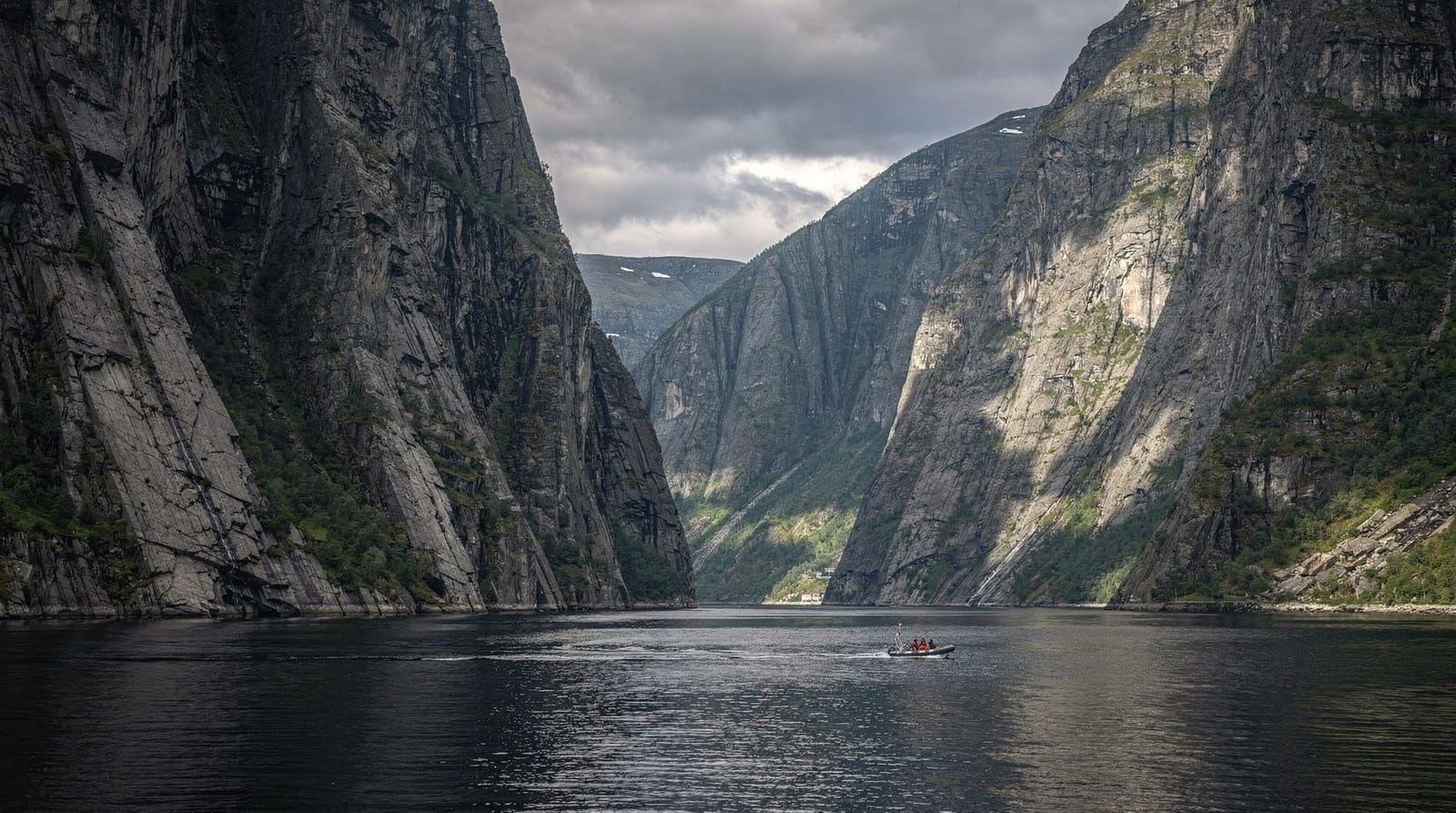
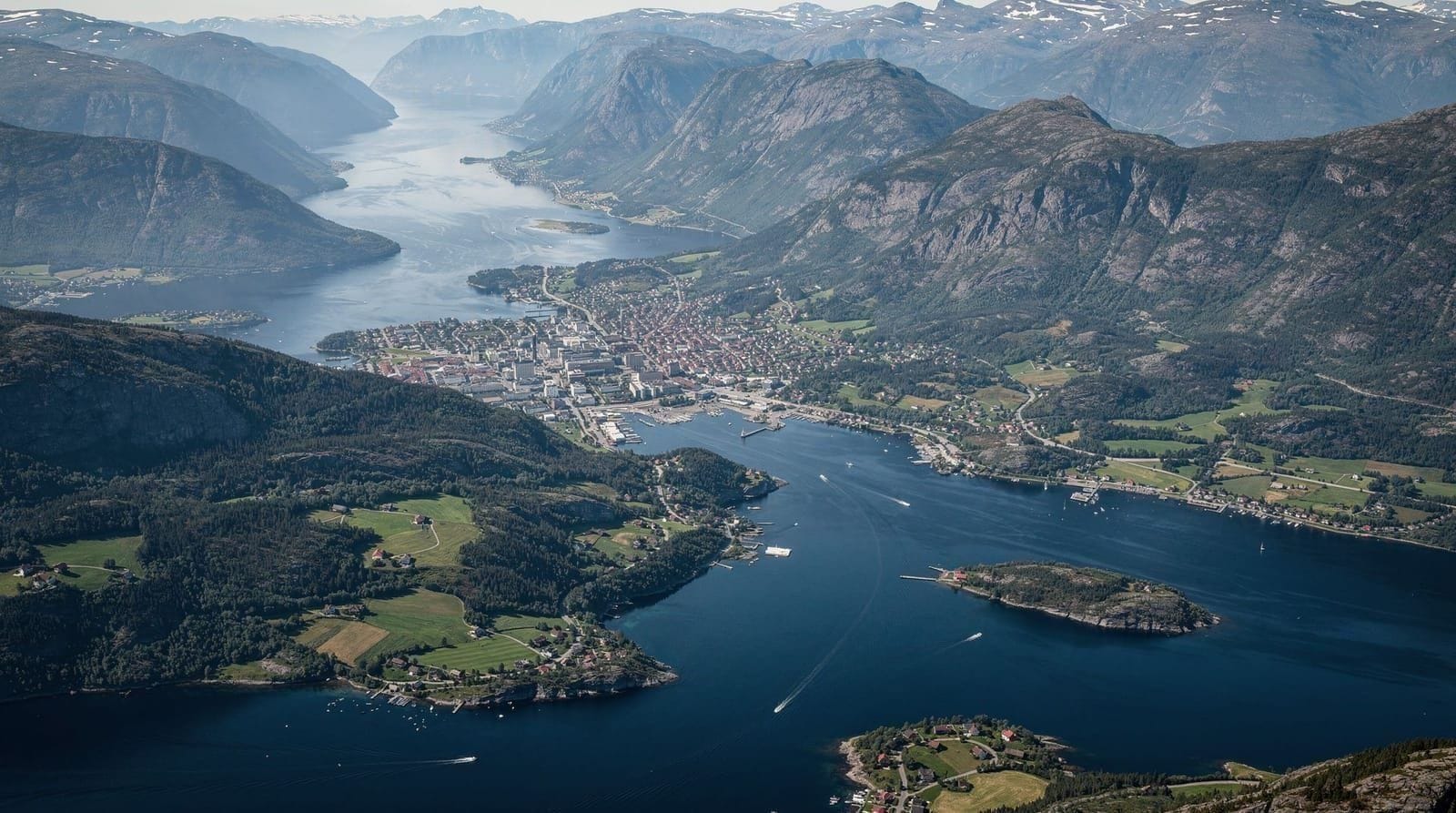
Lysefjord is a 42 km long fjord southeast of Stavanger, closed in on both sides by steep granite walls rising 600–1,000 m. The fjord itself is not easily accessed from Bergen — Stavanger is the natural base, and the distance between the two cities is significant enough (210 km, 4–5 hours by fast express boat or 3 hours by car plus a ferry) that Lysefjord is better approached as a destination requiring a separate leg of travel rather than a Bergen day trip.
But it contains two of the most iconic hiking viewpoints in Norway: Preikestolen (Pulpit Rock), the flat-topped cliff 604 m above the fjord, and Kjeragbolten, the boulder wedged in a crevice above a 1,000 m drop. Both have become globally recognisable images of Norwegian nature, which means both are extremely busy in peak season.
| Where | Southeast of Stavanger, ~210 km from Bergen |
| Time needed | 1–2 days, best with an overnight in Stavanger |
| Cost | Around NOK 2,500–3,500/person incl. one night |
| Getting there | Fly or express boat Bergen–Stavanger |
| Best time | May–October for hiking |
The logistics reality from Bergen
Bergen to Lysefjord requires either:
- Express boat Bergen → Stavanger (5.5 hours, NOK 450–650): Then Stavanger to the trailhead or cruise departure. A one-way journey of this length means an overnight in Stavanger is sensible.
- Car: Bergen → E39 highway south → Stavanger (~3 hours) → continue to the Preikestolen Fjellstue (trailhead base) via ferry from Tau (~40 minutes from Stavanger). Car + ferry + trailhead parking adds time and cost but gives flexibility.
- Fly Bergen–Stavanger: Approximately 35 minutes, from ~NOK 400–800. Stavanger airport (SVG) has frequent domestics. This is the fastest option for a dedicated Lysefjord trip from Bergen.
Lysefjord is not an easy Bergen day trip. A 14-hour round trip from Bergen by express boat, hiking Preikestolen, and returning the same day is theoretically possible but exhausting. Most visitors either base in Stavanger for 1–2 nights or include Lysefjord as part of a multi-day Western Norway circuit.
If you are still deciding how Lysefjord fits around your Bergen days, the Bergen travel budget guide helps you weigh the extra transport and overnight costs, and how many days in Bergen shows how much time you can realistically spare before heading south. For a longer loop that links the city with several fjords, the Western Norway 7-day itinerary is the broader frame.
Preikestolen (Pulpit Rock)
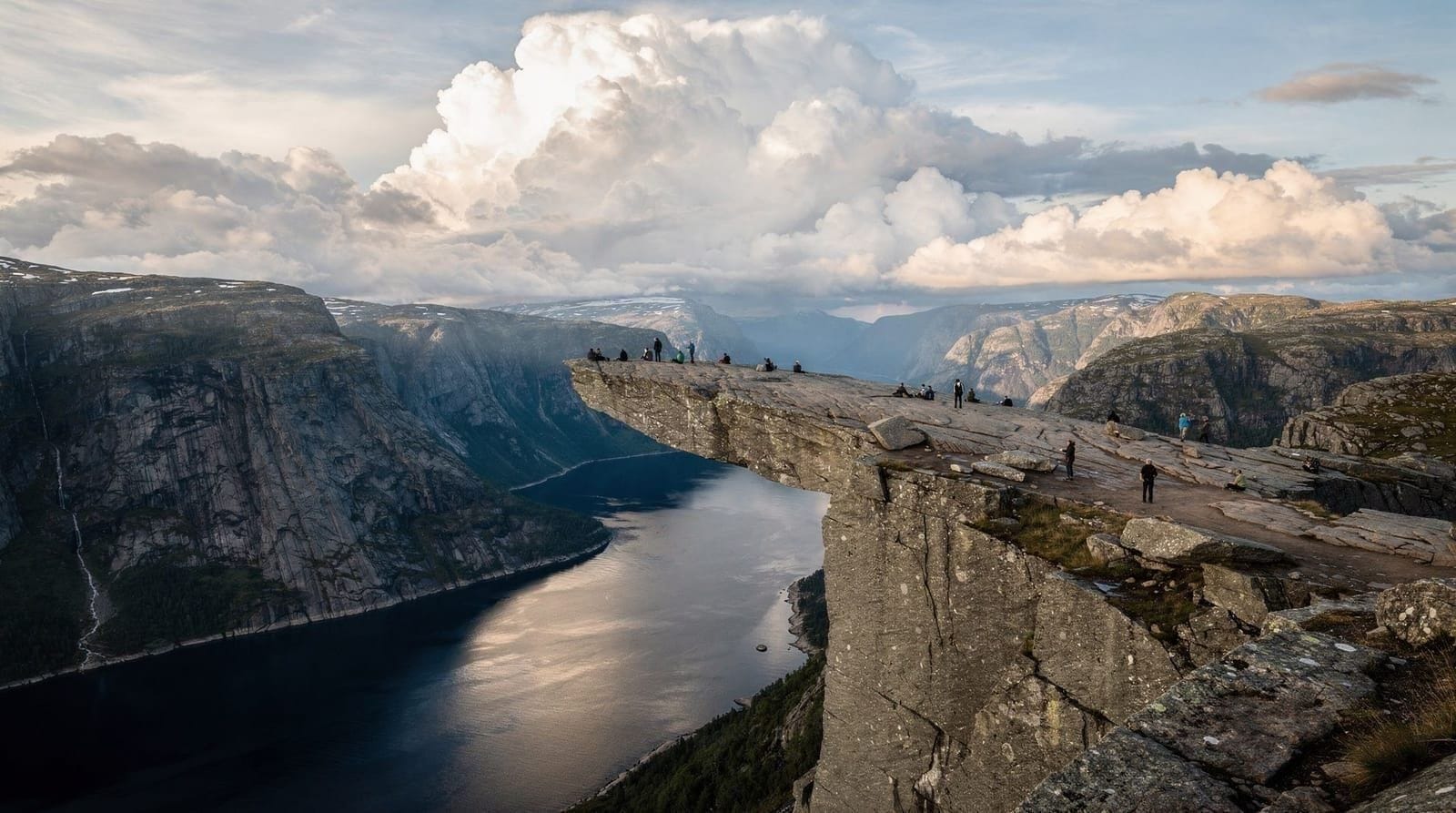
Preikestolen is a flat granite plateau approximately 25 m × 25 m, sitting 604 m above the fjord. There is no fence or railing. The cliff edge is a sheer vertical drop. On a clear summer day in July, upward of 4,000–5,000 people complete the hike.
The trail: 8 km round trip from the Preikestolen Fjellstue trailhead. Elevation gain: approximately 500 m. Estimated time: 3–5 hours for the round trip, depending on pace and crowd conditions at the top (the queue to stand at the rock’s tip in peak season adds 30–60 minutes). Trail surface: partly rocky, partly boardwalk, partly loose stone. Moderate difficulty — more demanding than a casual walk, less demanding than a mountain hike. Most fit adults complete it without prior hiking experience.
Season: Self-guided: May–October. November–April: crampons and ice experience required; guided hikes available year-round. Winter hiking on Preikestolen with snow and ice is technically more demanding and the fjord views can be spectacular on clear days — but conditions must be checked.
Practical logistics:
- Trailhead: Preikestolen Fjellstue (lodge and car park)
- From Stavanger: ferry from Stavanger harbour to Tau (40 min, NOK 60–80 per person, car ferry available), then 20 km by car/bus to the trailhead
- Parking: NOK 250/day at Preikestolen Fjellstue; a shuttle bus from Tau ferry dock runs in summer (NOK 80–100 each way)
- Start time: before 8 am in July–August to have the rock itself less crowded
- Facilities at top: none. Café and toilets at the Fjellstue (trailhead only).
A guided Preikestolen hike from Stavanger includes transport to the trailhead and a local guide — useful for anyone unfamiliar with Norwegian trail conditions or visiting out of peak season.
The Preikestolen hike guide covers the full trail description, photo spots, gear requirements, and what the rock actually looks like with 300 people standing on it (the honest version).
Preikestolen stands 600 metres above the Lysefjord, and the view of it from below is a different thing entirely from the view from on top: a fjord cruise to the Lysefjord and Pulpit Rock from Stavanger supplies the angle the hikers never get.
Kjeragbolten
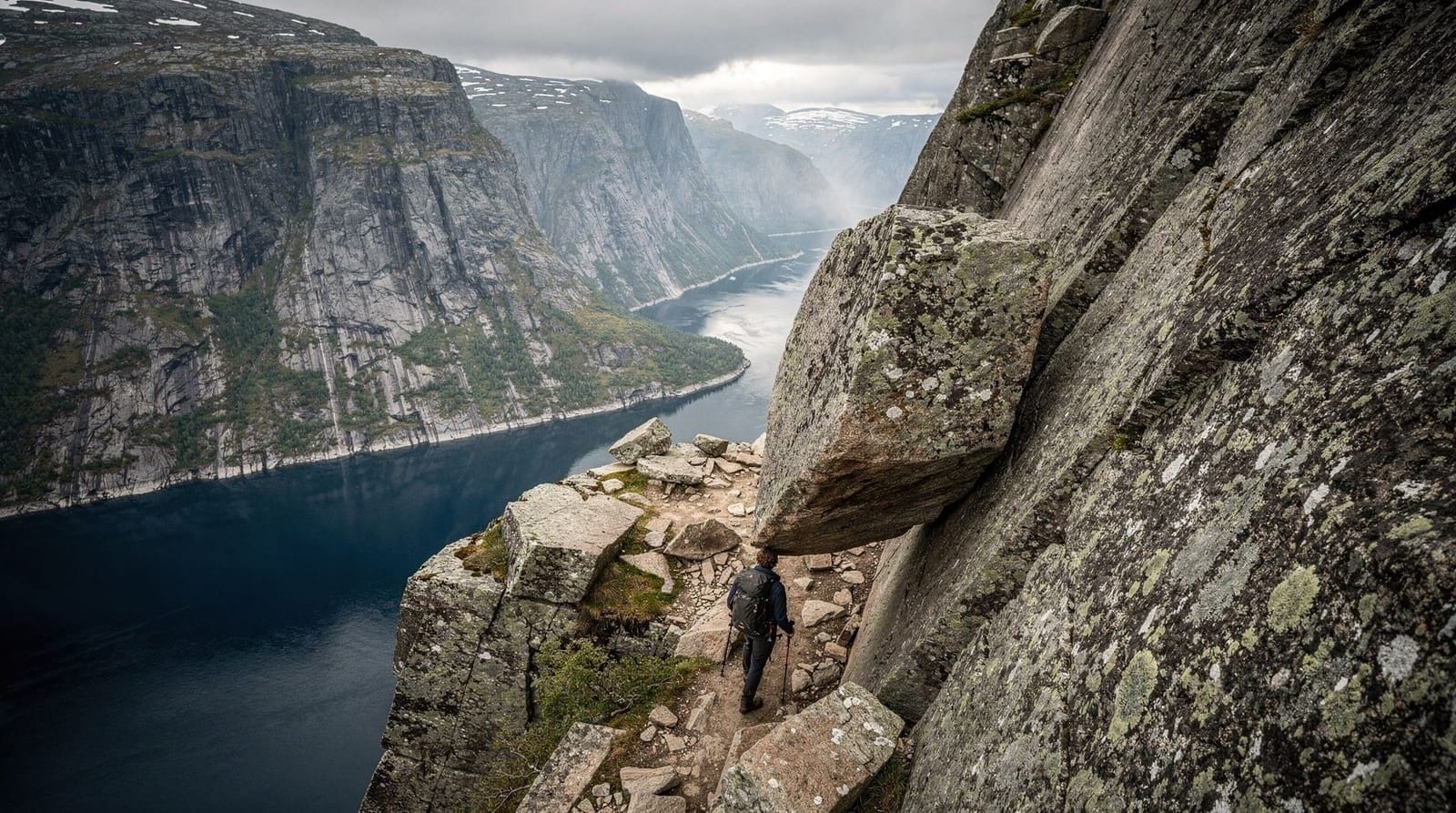
Kjeragbolten is a 5 m boulder wedged in a crevice in the cliff above Lysefjord at approximately 1,000 m elevation. The classic photograph — one person standing on the boulder over the void — is one of the most-reproduced adventure travel images in Norway. The reality: a queue of 30–60 people waiting for their turn on the boulder on a busy summer day.
The hike to Kjeragbolten: 10 km round trip, approximately 800–900 m elevation gain, 5–6 hours. Significantly more demanding than Preikestolen. The trail is steep and exposed in places, with chain-assisted sections near the top. Grade: challenging. Not recommended for inexperienced hikers or those with a fear of heights at exposure.
Access is from Øygardstøl, not from the Preikestolen trailhead — the two hikes are separate and on opposite sides of the fjord. Øygardstøl is accessible by car from Stavanger (1.5–2 hours) or by specific seasonal bus. Parking NOK 250.
Season: strictly May–October. Outside this period, snow and ice make the exposed trail technically dangerous without crampons and experience.
A guided Kjeragbolten hike handles transport from Stavanger to the Øygardstøl trailhead and includes an experienced mountain guide for the exposed upper sections.
Lysefjord cruise
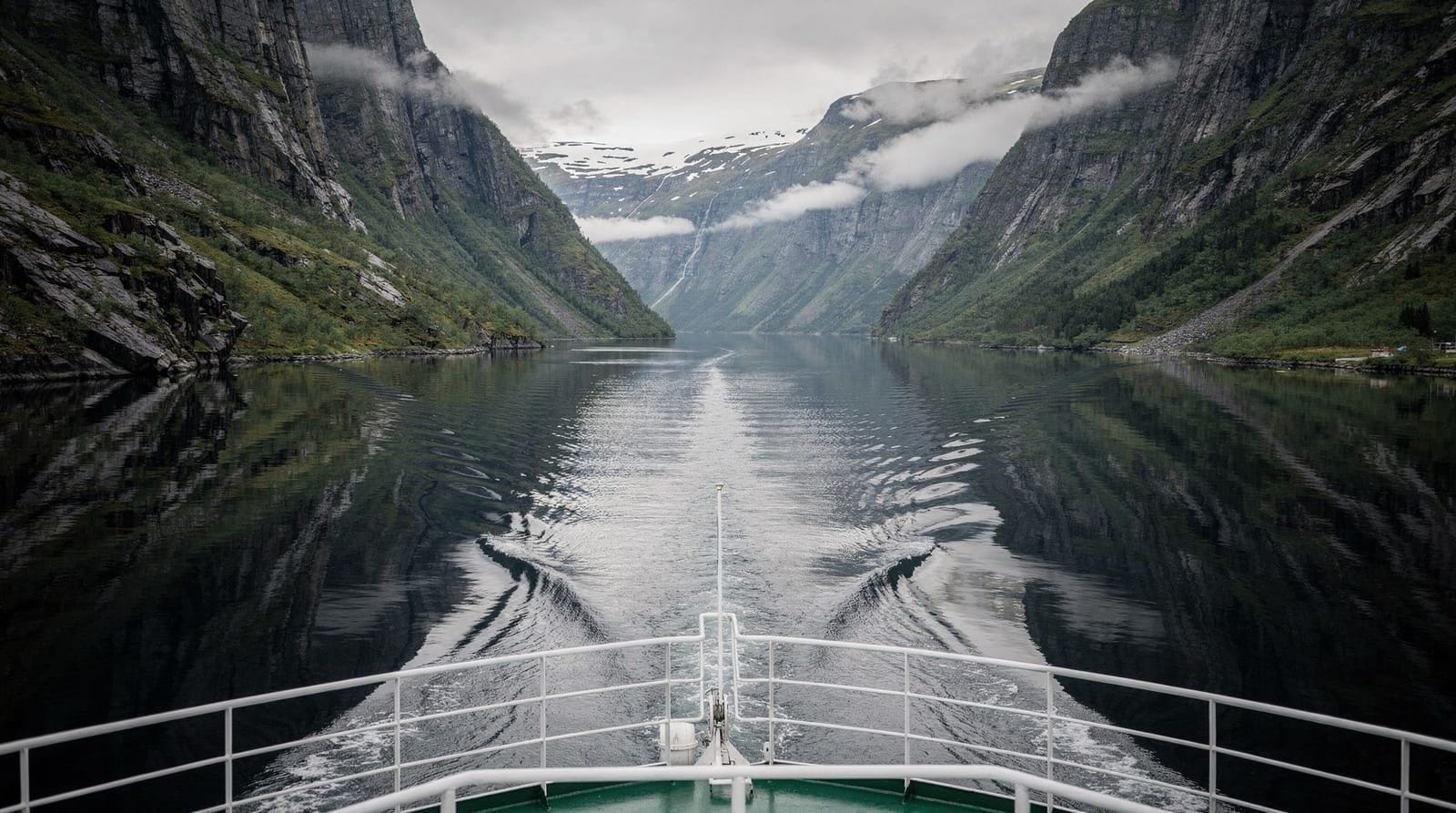
The Lysefjord cruise from Stavanger travels 42 km into the fjord under the base of Preikestolen cliff, offering an entirely different perspective from the hiking approach — you look up at the 604 m wall and see the tiny figures standing on the rock above. The cruise takes approximately 2–3 hours return. It runs year-round from Stavanger.
Operators include Rødne Fjord Cruise and Tide Reiser. Tickets: approximately NOK 500–700 per adult. The cruise passes the major waterfalls that feed into the fjord from the surrounding mountains, including Hengjanefossen. Commentary is in Norwegian and English.
The cruise option suits visitors who want to experience Lysefjord without the physical demands of the hikes, or who want to see the fjord from water level before or after a hike. For photography, seeing Preikestolen from below — with a scale reference of the boat below the cliff — gives context that the hike above does not provide.
Preikestolen vs. Kjeragbolten, compared
| Preikestolen | Kjeragbolten | |
|---|---|---|
| Distance/time | 8 km, 3–5 hours | 10 km, 5–6 hours |
| Elevation gain | ~500 m | ~800–900 m |
| Difficulty | Moderate, no technical skill needed | Challenging, chain-assisted exposed sections |
| Trailhead | Preikestolen Fjellstue | Øygardstøl (opposite side of fjord) |
| Best for | Most fit hikers, first-time visitors | Experienced hikers wanting less-crowded exposure |
Winter access to either trail changes the calculus considerably — outside the May–October window, both require crampons, ice experience, and ideally a guide.
A guided winter hike to Preikestolen provides the crampons, navigation, and local knowledge that self-guided winter access requires.
Stavanger as a base
Stavanger is Norway’s fourth-largest city and the base for any Lysefjord visit. It is a compact, attractive city with the preserved 18th-century wooden house district (Gamle Stavanger — the best-preserved collection of old wooden houses in Northern Europe), a strong oil-industry museum (Norwegian Petroleum Museum, NOK 160), a good restaurant scene fuelled by oil-sector money, and a genuine old harbour (Vågen) with working fishing boats.
One night in Stavanger is sufficient to use it as a Lysefjord base; two nights if you want to include both Preikestolen and Kjeragbolten plus city time.
Accommodation range in Stavanger: hostels from NOK 400 dorm; mid-range from NOK 1,200–1,800 per double; premium from NOK 2,000+. Summer prices are lower than in Bergen because Stavanger has less tourist infrastructure per square metre.
Camping near Preikestolen
Preikestolen Fjellstue at the trailhead is the most practical base for the hike. Beyond the lodge, wildcamping is permitted in Norway above the tree line, and experienced hikers can camp on the Preikestolen plateau or in the valley below with permits. The Norwegian outdoor access law (Allemannsretten) gives the right to camp in uncultivated land more than 150 m from the nearest dwelling for up to two nights — this applies at the plateau above the lodge.
Camping on the Preikestolen plateau gives you the experience of standing at the rock at dawn before the day-trippers arrive — the queue that forms by 10 am in July is entirely absent at 6 am. Carry full tent equipment; temperatures drop to near-freezing at this altitude even in July nights.
Lysefjord waterfalls and wildlife
The fjord receives meltwater from the surrounding mountains through numerous waterfalls, the most dramatic of which is Hengjanefossen — a waterfall visible from the cruise route that drops directly into the fjord. In spring and early summer (May–June), when snowmelt is at its peak, these waterfalls are at their fullest.
The Lysefjord is home to harbour porpoises and occasional common seals. White-tailed eagles nest on the cliff faces above the fjord — a common and impressive sight year-round. Guided RIB (rigid inflatable boat) tours of the fjord use smaller, faster craft that can approach the waterfall bases and cliff faces that the larger cruise ferries cannot reach.
Gamle Stavanger (Old Stavanger)
If you are basing in Stavanger for the Lysefjord visit, Gamle Stavanger — the preserved wooden house district on the western shore of the harbour — merits 90 minutes of walking time. The neighbourhood contains over 170 white-painted wooden houses from the 18th and early 19th century, maintained as a living residential district rather than a museum. It is the best-preserved collection of old wooden urban buildings in Northern Europe.
The streets are narrow, paved with flat stones, and quiet enough even in summer that you can walk them without crowds. Several galleries and artisan workshops operate from converted houses. Free to walk; no opening hours or tickets required.
Norwegian Petroleum Museum
Stavanger’s identity as an oil city (North Sea production began offshore here in the 1970s) is documented at the Norwegian Petroleum Museum (Norsk Oljemuseum) on the harbour. It is not the dry institutional exhibit its name suggests — the museum covers the engineering, politics, and human experience of offshore oil through well-designed interactives and recovered platform equipment. Entry: NOK 160 adult; children under 16: free. Useful for a rainy afternoon before or after the Lysefjord hike.
Combining Lysefjord with Western Norway
The most practical multi-day circuit combining Bergen and Lysefjord:
- Day 1–2: Bergen city
- Day 3: Express boat Bergen → Stavanger (5.5 hours, scenic)
- Day 4: Preikestolen hike or Lysefjord cruise
- Day 5: Kjeragbolten (optional; requires a full day)
- Day 6: Fly or boat Stavanger → Bergen
This circuit appears in the Bergen and fjords 5-day itinerary.
The best day trips from Bergen guide discusses whether Lysefjord is a realistic day trip from Bergen (honest answer: technically yes by boat or flight, but an overnight in Stavanger is a better experience).
Costs at Lysefjord and Stavanger
Transport (from Bergen):
- Express boat Bergen → Stavanger (5.5 h): NOK 450–650 per person
- Flight Bergen → Stavanger (35 min): NOK 400–800 depending on advance booking
- Ferry Stavanger → Tau (for Preikestolen): NOK 60–80 per person; car supplement NOK 150–200
- Shuttle bus Tau → Preikestolen trailhead: NOK 80–100 each way
Activities:
- Preikestolen hike: free to hike; parking NOK 250/day
- Preikestolen guided hike (from Stavanger): NOK 650–900 per person
- Kjeragbolten guided hike (from Stavanger): NOK 800–1,100 per person
- Lysefjord cruise (2–3 hours return): NOK 500–700 per adult
- Preikestolen Fjellstue overnight (lodge): NOK 450 dorm, NOK 1,600–1,800 double
Stavanger accommodation:
- Budget hostel dorm: NOK 350–500
- Mid-range hotel double: NOK 1,200–1,800
- Preikestolen Fjellstue (trailhead lodge): NOK 1,600–1,800 double peak season
A Lysefjord trip from Bergen requiring one night in Stavanger costs approximately NOK 2,500–3,500 per person (transport both ways, accommodation, one activity). The flight option rather than express boat saves time but adds roughly NOK 200–400 per person.
What Preikestolen actually looks like in July
The honest picture of Preikestolen in peak summer: you complete the 4-hour round trip trail and arrive at the rock to find 200–400 people standing on a platform the size of half a tennis court. A queue forms for the edge. There are no barriers. People take photos in turn at the front. Social media photographs of a solitary figure on an empty rock require either a very early start (before 7 am, which means a 5 am departure from the trailhead) or a weekday in May or September.
The view from the rock across Lysefjord — regardless of crowd — is genuine and striking. The scale of the drop (604 m) combined with the flatness of the platform creates a vertigo effect that no photograph fully captures. Most visitors find the experience worthwhile despite the crowds. But arriving expecting a solitary wilderness encounter in July is a misalignment of expectations.
The Lysefjord cruise sees the rock from below, with the entire cliff face visible. A useful complement to the hike rather than an alternative.
Pack for changeable mountain weather whichever trail you choose; the what to pack for Bergen guide covers layers and footwear that work just as well on the Stavanger side, and the fjord cruises from Bergen guide is the place to compare if you decide a closer boat trip is enough.
If you’re weighing Lysefjord against a closer option, the Hardangerfjord guide and Sognefjord guide cover fjords reachable in a fraction of the travel time from Bergen, and Bergen’s own hiking guide covers Fløyen and Ulriken for a shorter, no-flight alternative to Preikestolen-scale hikes.
Frequently asked questions about Lysefjord
Is Preikestolen difficult to hike?
It is a moderate hike — genuinely physically demanding if you are not used to walking on uneven terrain, but accessible to most reasonably fit adults without technical skills. The 500 m elevation gain is spread over 4 km; the surface is mostly rocky path and boardwalk. The psychological challenge for some visitors is the exposed rock platform with no barriers at the top. If exposure to heights is a significant issue, the fjord cruise gives you the Lysefjord experience without the height exposure.
Can you see Preikestolen from the fjord cruise?
Yes. The Lysefjord cruise passes directly below the Preikestolen cliff and the rock is visible from the boat. At 604 m height, it appears as a relatively small protrusion against the cliff face — but the scale of the drop becomes apparent when you can see boats on the water far below. For a sense of the fjord’s full scale, the cruise view is arguably more informative than the hiking view.
Is Lysefjord accessible in winter?
The fjord cruise operates year-round. Preikestolen and Kjeragbolten hikes in winter require crampons, ice experience, and ideally a guide — the trails are beautiful in snow but genuinely more dangerous. Several operators in Stavanger run guided winter hikes to Preikestolen.
How long does it take to get from Bergen to Preikestolen?
By the fastest route: fly Bergen to Stavanger (35 min, plus airport time) + ferry Stavanger to Tau (40 min) + bus to trailhead (30 min). Minimum 3–4 hours from Bergen city centre to the trailhead, including transit time. By express boat from Bergen to Stavanger (5.5 hours) then continuing to the trailhead: you are looking at an 8-hour journey one-way. This is why most serious visits require an overnight in Stavanger.
What is the difference between Preikestolen and Kjeragbolten?
Preikestolen (Pulpit Rock) is a flat platform 604 m above the fjord — accessible to most fit hikers, 4–5 hours round trip, extremely popular. Kjeragbolten is a single boulder in a crevice 1,000 m above the fjord, accessed via a more demanding and exposed trail (5–6 hours, steep sections). Preikestolen is the priority for first-time visitors; Kjeragbolten appeals to more experienced hikers who want a less-photographed (though still busy) experience.
Can you combine Preikestolen and Kjeragbolten in one trip?
Yes, over 2–3 days based in Stavanger. Preikestolen on day one (leave early from Stavanger, returning mid-afternoon), rest day or Stavanger city exploration, Kjeragbolten on day two or three. The two trailheads are in different directions from Stavanger and require full separate days — they cannot be combined in a single day.
Is the Lysefjord cruise suitable for children?
Yes. The cruise is a 2–3 hour boat journey with calm water (Lysefjord is sheltered from ocean swell) and dramatic scenery at water level. It is more comfortable for young children than a demanding hike and gives a strong sense of the fjord’s scale. Children under 4 typically travel free; children 4–15 at reduced rates. Check the operator’s current age policy.
Does Lysefjord have accommodation options?
Preikestolen Fjellstue (the lodge at the trailhead) has dormitory and private rooms — prices from NOK 450 dorm to NOK 1,800 double in summer. Booking essential in July. Staying at the lodge allows a very early start for the hike before day-trippers arrive from Stavanger. Otherwise, Stavanger is the practical base.
Top experiences
Bookable activities with verified prices and instant confirmation on GetYourGuide.