Northern lights from Bergen — the honest guide (and why you should go further north)
Bergen Winter Night Hike with Headlamps | ViFlowExperience
Can you see the northern lights from Bergen?
Technically possible but reliably unlikely. Bergen sits at 60.4°N — in the aurora zone but one of Norway's cloudiest cities (~230 rainy days/year). Faint aurora is visible a few times per winter from Bergen's hilltops after strong geomagnetic storms. For reliable northern lights, Tromsø (69°N) or Lofoten are the correct destinations — significantly further north, drier skies, dedicated aurora infrastructure.
Bergen sits at 60.4° north latitude, which places it within the theoretical aurora zone — but barely. The magnetic latitude is similar to parts of southern Alaska or northern Scotland where northern lights are occasionally seen, not the reliable display zone of Tromsø, Svalbard, or Alta further north. Before planning a Bergen trip around aurora viewing, the numbers deserve an honest look.
This guide covers what is actually possible from Bergen, when it happens, what conditions are required, and — most importantly — what to do instead if northern lights are a primary travel goal.
| Odds from Bergen | Low but real — a handful of nights per winter with strong storms |
| Cost | Free (self-viewing); guided night hikes around NOK 400–600 |
| Time needed | A few hours, after dark (roughly 7pm–1am) |
| Getting there | Fløibanen to Mount Fløyen, or Ulriken cable car |
| Best time | September–October and February–March |
The latitude reality
The aurora borealis (northern lights) is concentrated in an oval-shaped zone centered around the magnetic north pole, typically at magnetic latitudes of 65–72°N for strong displays. Bergen’s magnetic latitude is approximately 57°N — inside the zone for very strong geomagnetic events but well below the optimal band.
For comparison:
- Tromsø: 69.6°N geographic, magnetic latitude approximately 66°N. In the core aurora oval. Visible 200+ nights per year.
- Lofoten: 68°N geographic. Strong and frequent displays from September to March.
- Bergen: 60.4°N geographic. Occasional displays only; requires geomagnetic storm conditions (Kp index 5+).
The Kp scale runs 0–9; Bergen requires roughly Kp 4–5 for faint aurora, Kp 6+ for a display visible without optimal conditions. Strong geomagnetic storms producing Kp 6–9 occur several times per year — when they do, Bergen can see aurora. But they cannot be predicted more than 24–48 hours in advance, and they do not reliably coincide with clear skies in Bergen.
The cloud problem
Bergen averages approximately 230 rainy days per year, making it one of the wettest cities in Europe. It is also frequently overcast without rain — the city’s position on the Atlantic coast, between the open North Sea and the inland mountain ranges, creates persistent cloud cover in autumn and winter.
An aurora viewing session requires: dark skies, clear sky (no cloud), and sufficient geomagnetic activity. Bergen’s cloud statistics make “clear sky” the binding constraint. Even when Kp is high enough for Bergen-latitude aurora, the probability of simultaneously having a clear sky in Bergen in winter is low.
Western Norway’s east-of-Bergen areas (Voss, inland valleys) are statistically drier because they are shielded from the coastal weather by the mountains. This does not make them aurora-tourism destinations; it means the odds are marginally less bad.
Comparing cloud cover data:
- Bergen averages 210–230 overcast days per year at sea level
- Voss averages 170–190 overcast days per year (inland valley, mountain rain shadow)
- Tromsø averages 130–150 overcast days per year on the coast, lower inland
- Kautokeino and Karasjok (inland Finnmark): 90–110 overcast days per year — the best aurora weather in Norway
The cloud data explains why even dedicated aurora chasers who base in Tromsø sometimes drive 2–4 hours inland to escape coastal cloud. From Bergen, the drive to genuinely drier conditions reaches the Hardangervidda plateau — but this is 2–3 hours by car and still not in the optimal aurora oval.
When northern lights are possible in Bergen
The aurora season runs from late September to late March — when nights are dark enough to see the display. Bergen’s summer (May–August) has essentially no darkness during aurora season; there is no aurora visible in Bergen in summer regardless of geomagnetic conditions.
The best Bergen aurora conditions are:
- September–October: First dark nights, lower cloud frequency than deep winter, Kp activity still elevated from solar cycle
- February–March: Solar activity often peaks; days are lengthening but nights still dark enough
Statistically, December–January are the darkest months but also among the cloudiest and stormiest in Bergen. Counterintuitively, September and February/March are the more practical aurora months for Bergen.
Northern lights in the context of Western Norway travel
The northern lights question often comes up when people are planning a broader Western Norway fjord trip — they want to know if Bergen can serve as both the fjord base and the aurora destination. The honest answer is that these are largely incompatible goals for a single trip.
The fjord trip timing: The best fjord weather is May–September. The Flåm Railway, Nærøyfjord cruise, and mountain hikes are best in this window. Bergen’s outdoor adventure options peak in summer.
The aurora timing: Aurora requires darkness, which means September–March. The best aurora months for Bergen’s latitude are September–October and February–March.
The narrow overlap: September is the one month where reasonable fjord access (Mostraumen cruise runs year-round; the Flåm Railway has reduced but real service) combines with the beginning of aurora potential. September foliage is also excellent for photography.
If you want to attempt both fjords and northern lights from Bergen in a single trip, target September. Accept reduced fjord options compared to July but better odds for aurora than December. See the best day trips guide for which day trips remain viable in September.
Where to look from Bergen if aurora is possible
If you are in Bergen and a strong geomagnetic event (Kp 5+) is forecast, the best viewing options are:
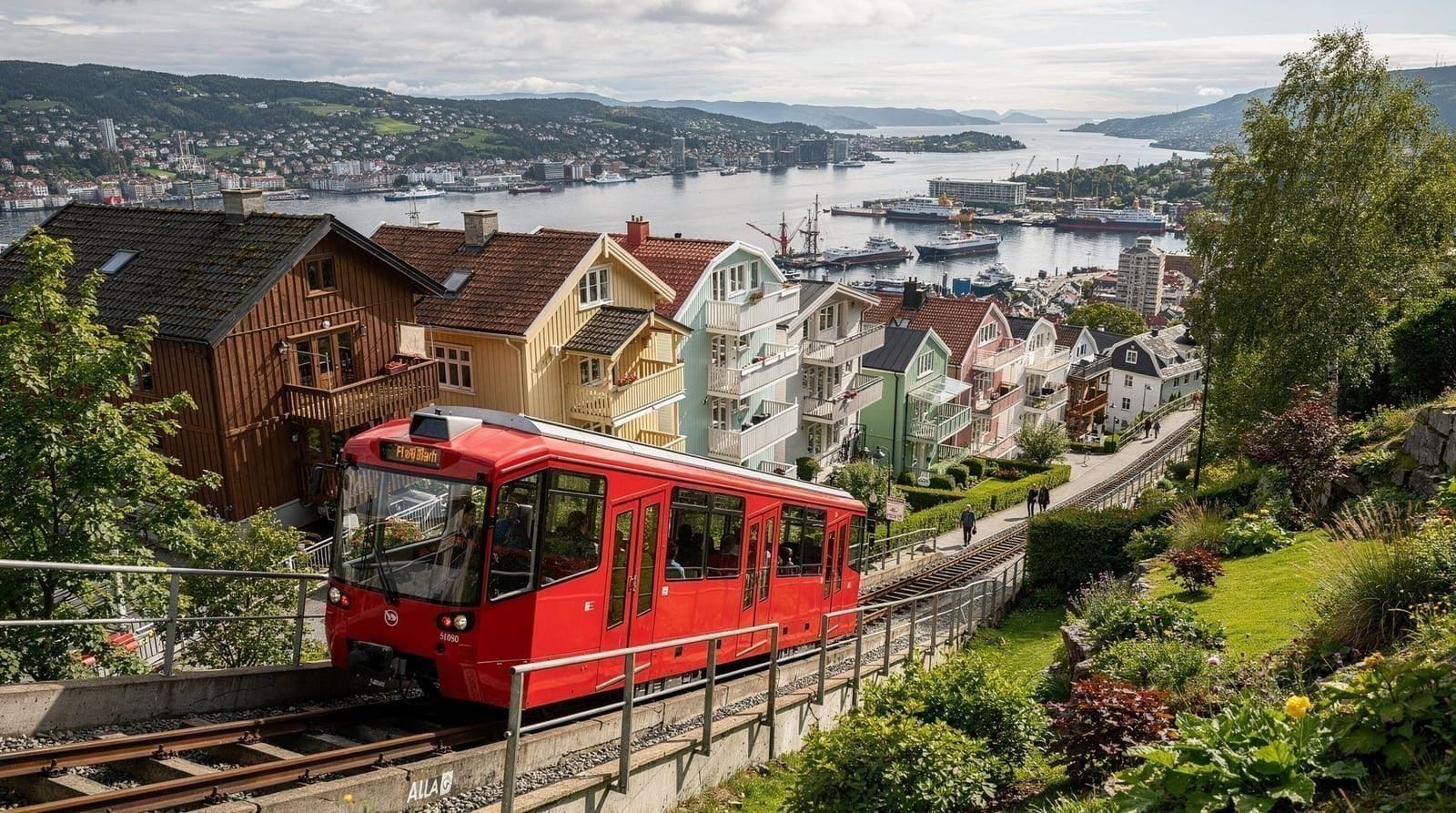
Mount Fløyen summit: The Fløibanen funicular runs until 11 pm in winter. At 320m, you are above some of the city light pollution and at the elevation of the mountain ridge. The view faces north and east. This is Bergen’s best accessible aurora viewpoint.
Mount Ulriken: Higher at 643m, accessible by cable car (check late operating hours) or a 2–3 hour hike. Even better elevation; even further from city lights.
Sandviken and north-facing harbor views: Some visible aurora has been reported from Bergen’s harbor area during extreme Kp events (7+) when the display is bright enough to overcome urban light pollution. This is not a dedicated aurora viewpoint.
The critical conditions from Bergen: Kp 5 or higher, completely clear sky, after astronomical twilight (roughly 7–9 pm in autumn/winter), and facing north away from the most intense city lights.
If you want a structured way to be on Fløyen after dark rather than gambling on a solo evening trip, a guided winter night hike with headlamps covers the same terrain with a local guide and proper safety preparation — genuinely useful if a Kp alert fires during your stay and you want to head up quickly without navigating the plateau paths alone in the dark.
Bergen winter night hike with headlampsHow to monitor for aurora in Bergen
Three useful tools:
Space Weather Prediction Center (spaceweather.noaa.gov): US government agency. 3-day Kp forecasts, 1-hour updated predictions. The most reliable source. Kp 5+ from Bergen means aurora is possible.
Yr.no: Norway’s official weather service, showing cloud cover with high accuracy for Bergen specifically. Clear sky symbol needed; even “partly cloudy” usually means enough cloud to block aurora.
Aurora forecast apps: SpaceWeatherLive, Aurora Forecast, My Aurora Forecast all provide Kp-threshold alerts you can configure for Bergen’s latitude.
The useful alert combination: Kp 5+ (NOAA) AND clear sky (Yr.no) AND dark night (astronomical twilight ended). These three conditions occurring simultaneously in Bergen between October and March is an uncommon event — but it does happen, roughly 3–6 times per winter.
Why you should go to Tromsø or Lofoten instead
If northern lights are a primary travel goal, Bergen is the wrong destination. This is not meant to discourage Bergen visits — it is honest information that matters for planning.
Tromsø (69.6°N): Norway’s aurora capital. Darker, clearer, further in the aurora oval. Hundreds of organized aurora tours operate from Tromsø nightly in season. Direct flights from Bergen (1 hour 30 min, NOK 600–1,500 depending on advance booking). The city has built an entire tourism industry around aurora: chase vehicles with professional guides, known parking spots for clear skies, heated bases to wait comfortably. Visitors report aurora on the majority of clear nights from September to March.
Lofoten: Dramatic island archipelago at 68°N with famous fishing villages and mountainous skylines that make aurora photography exceptional. Less tourism infrastructure than Tromsø but increasingly well-organized. Flights from Bergen to Bodø (1h 20min) + ferry or additional short flight to the islands.
Northern Norway self-drive: Renting a car from Tromsø in February and driving inland away from coastal cloud is the most reliable aurora strategy. The interior of Troms and Finnmark is statistically much drier than the coast.
Bergen as an aurora “try your luck” destination
Bergen is a perfectly reasonable base for an early-autumn or late-winter Norway trip where aurora is on the wish list but not the sole purpose. If you are visiting Bergen for fjords, Bryggen, and the mountains, and aurora appears in the forecast during your stay — the Fløibanen summit and the Ulriken viewpoints are worth a late-evening attempt.
Managing expectations: you will probably not see the northern lights from Bergen. You might. The probability on any given night in winter is low. Do not choose Bergen over Tromsø if aurora is why you are coming to Norway.
Understanding the solar cycle and Bergen aurora probability
Aurora activity is driven by the sun’s 11-year activity cycle. Solar maximum — when sunspot activity and geomagnetic storms are most frequent — produces significantly more aurora events at all latitudes, including Bergen’s.
The current solar cycle (Cycle 25) peaked around 2025–2026, making this period the most favorable for Bergen-latitude aurora in a decade. More frequent Kp 5–7 events mean more chances for Bergen viewings during this window. As the cycle moves toward solar minimum (expected approximately 2030), Bergen aurora will become rarer again.
Checking NOAA’s solar cycle progression is a useful planning tool if aurora at Bergen’s latitude is on your wishlist: during a solar maximum year, a Bergen winter trip has meaningfully better aurora prospects than the same trip during solar minimum.
Real-time data sources:
- spaceweather.noaa.gov — NOAA’s 3-day aurora forecast with Kp index
- aurorasaurus.org — crowdsourced aurora sightings mapped by latitude
- yr.no — Bergen-specific cloud cover forecast (hourly resolution)
- SpaceWeatherLive app — push notifications when Kp threshold is reached
Setting a Kp 5 alert on SpaceWeatherLive during a Bergen visit costs nothing and means you will not miss a potential event while sleeping through it.
If you are also deciding when to travel for the best overall balance of weather and daylight, the best time to visit Bergen guide puts the aurora months in context with the rest of the year. For viewpoints that work as well by day as at night, the best photo spots in Bergen post is a useful companion.
What a realistic Bergen aurora attempt looks like
To set expectations concretely: a traveler spending 5 nights in Bergen during late September has a reasonable, not high, chance of one clear, high-Kp night. The practical routine looks like this — set a Kp 5 alert on SpaceWeatherLive before your trip, check Yr.no’s Bergen cloud forecast each evening around dinner time, and if both align, head to Fløibanen’s last car (check the winter timetable) or the Ulriken cable car rather than waiting to see if conditions hold. Waiting costs you the short weather window Bergen’s coastal climate tends to offer.
Across 5 nights in the September or February shoulder windows, most visitors who actively monitor conditions see aurora on 0–1 nights — a realistic outcome, not a guaranteed one. Visitors who do not check conditions and simply hope tend to see nothing, even during a stay that included a qualifying storm, because they were not outside and facing the right direction at the right time.
Aurora photography from Bergen
If you are in Bergen during a Kp 5+ event with a clear sky, photographing aurora from the Fløibanen summit is achievable with basic camera knowledge:
Camera settings: Manual mode. ISO 800–3200 (start at 1600). Aperture f/2.8 or wider. Shutter speed 5–15 seconds (shorter if aurora is moving fast). Focus manually to infinity. Use a tripod — handheld exposures of this length produce blur.
Smartphone: Modern smartphone cameras (iPhone 15+, Google Pixel 8+) can capture faint aurora with Night Mode or Pro mode. Less reliable than a dedicated camera with a wide aperture lens but usable for a record shot.
Composition from Fløyen: Aim north from the summit viewpoint with Bergen’s harbor lights below — the city’s glow in the foreground adds context to an aurora shot rather than simply detracting from it. The Bryggen frontage visible from above creates a recognizable Bergen anchor for aurora photographs.
Timing: Aurora activity often intensifies in the hours around local magnetic midnight, which in Bergen occurs around 11 pm–1 am. The Fløibanen last departure in winter is 11 pm; factor this into timing if you intend to stay at the summit.
What Bergen is genuinely good for in the aurora season
If you are visiting Bergen in October, November, or February, the city is excellent for reasons unrelated to aurora:
- Fewer crowds than summer (Bergen’s museum circuit is dramatically less crowded)
- Lower hotel prices (30–50% below peak summer rates)
- Autumn foliage (September–October) and a different, quieter character
- Christmas market in December at Festplassen
- Winter hiking with headlamps on Mount Fløyen
- The Fløibanen in snow (when it occurs; sea-level snow is not guaranteed in Bergen but happens)
What winter Bergen does not offer: The fjord cruise circuit is largely suspended from October through April. Norway in a Nutshell runs on a reduced timetable. High mountain hikes (Trolltunga, Preikestolen) require guides and equipment. If outdoor adventure is your primary reason for visiting, winter is the wrong season for Bergen regardless of aurora prospects.
For a complete picture of Bergen’s winter, including what is open and what typical weather looks like month by month, see the Bergen in winter guide.
Cloudy evenings are the norm, so it helps to have a plan B for the days when the sky stays shut. Rain-proof options are covered in Bergen in the rain and in the rainy day Bergen blog post. If you would rather spend a dry spell in the old town than on a hilltop, Bryggen and the Hanseatic wharf is atmospheric after dark, and a local guide can add context you would miss alone, for example on a guided walking tour of the city centre on foot.
Packing matters more than most visitors expect for late-night viewpoint waits: the what to pack for Bergen guide covers the layers that make standing still on a ridge bearable. If you plan to combine the city with a longer trip, the Bergen 2 days itinerary and the Bergen and fjords 5 days itinerary show how to fit an optional evening outing into a normal sightseeing schedule.
Bergen vs. Tromsø vs. Lofoten: the direct comparison
For travelers actively weighing destinations rather than just curious about Bergen’s odds, this table puts the numbers side by side:
| Bergen | Tromsø | Lofoten | |
|---|---|---|---|
| Latitude | 60.4°N | 69.6°N | 68°N |
| Overcast days/year | 210–230 | 130–150 | Similar to Tromsø, variable |
| Minimum Kp for visible aurora | 4–5 (faint), 6+ (clear) | 2–3 | 2–3 |
| Organized aurora tours | Informal only | Extensive, nightly | Growing, less extensive than Tromsø |
| Flight from Bergen | — | 1h30, NOK 600–1,500 | Via Bodø, ~1h20 + onward transfer |
| Verdict | Bonus if visiting for fjords/city | Correct choice if aurora is the goal | Correct choice for aurora + landscape photography |
The honest summary: if aurora is even a secondary priority and your schedule allows it, flying from Bergen to Tromsø for 2–3 nights during your trip delivers a dramatically better probability of success than staying in Bergen and hoping.
The honest summary — making the decision
Should you choose Bergen over Tromsø for a northern lights trip?
If aurora is the primary purpose of your Norwegian visit: no. Tromsø is the correct destination. The probability gap is enormous — Tromsø delivers visible aurora to most clear-sky visitors; Bergen delivers it to a minority of clear-sky visitors during strong geomagnetic events.
If you want to visit Bergen for its fjords, culture, and city sightseeing, and aurora would be a bonus: yes, go to Bergen. The winter season is underpriced and underappreciated. The city’s outdoor adventure options, KODE museums, and food scene are fully available in winter. Aurora might happen; if it does, you will be glad you set a Kp alert.
If budget matters: Bergen winter flights and accommodation are significantly cheaper than Tromsø in peak aurora season. A Bergen winter trip that happens to catch a Kp 6 event during your stay costs less than half of a dedicated Tromsø aurora tour package.
Frequently asked questions about northern lights from Bergen
What Kp level is needed to see northern lights in Bergen?
Kp 4–5 for faint display visible from dark hilltops; Kp 6+ for a display that might be visible from the harbor. Kp 7–9 (severe storms) can produce visible aurora even with some light pollution. Kp indices below 4 will not produce visible aurora at Bergen’s latitude under any conditions.
What is the best month for northern lights in Bergen?
September and early October are the most practical — nights are dark again after the midnight-sun season, cloud frequency is slightly lower than winter, and the solar cycle often produces elevated geomagnetic activity. February and March are the second choice.
Has anyone actually seen northern lights in Bergen?
Yes. Strong geomagnetic storms (Kp 6–9) occur several times per winter and produce visible aurora across much of Norway including Bergen. Bergen residents post aurora photos from Mount Fløyen regularly during such events. The caveat is that the photo opportunity requires: Kp 6+, clear sky, and you being in Bergen during those specific hours.
Is there an organized aurora tour from Bergen?
Some Bergen operators run informal “aurora alert” notification systems and small group trips to the mountain viewpoints when conditions align. These are not the structured, nightly-departure aurora tours available in Tromsø — they are opportunistic. Search for “northern lights Bergen” on local tour platforms to find current offerings.
Why is Tromsø better for northern lights than Bergen?
Tromsø is 9° further north, placing it firmly in the aurora oval where Kp 2–3 is sufficient for visible displays. Bergen needs Kp 5+ for even faint aurora. Additionally, the interior of Troms region is significantly drier than Bergen’s Atlantic coast, giving more cloud-free nights. The combination of better latitude and better weather makes Tromsø dramatically more reliable.
Can I see the Milky Way from Bergen?
Bergen’s light pollution reduces Milky Way visibility from the city. From the summit of Mount Fløyen or Ulriken on clear moonless nights, some Milky Way is visible toward the south. For serious dark-sky viewing, travel inland or to less-populated areas of Western Norway.
Is Bergen worth visiting in winter for non-aurora reasons?
Yes, genuinely. Bergen in winter has a different, quieter character. The city’s cultural offerings — KODE museums, Bryggens Museum, restaurants, the Christmas market — are all active. The Fløibanen operates year-round. Fjord day trips are reduced but not eliminated. Prices are significantly lower than summer. The honest caveat: Bergen’s winter weather (rain, wind, short days) is demanding. Visitors who embrace it tend to find it atmospheric rather than discouraging.
Should I add a Tromsø side trip to my Bergen itinerary specifically for aurora?
If aurora is a genuine priority and your trip includes September–March dates, yes — a 2–3 night Tromsø add-on (1h30 flight from Bergen) is the single most effective change you can make to your odds. It is not necessary if aurora is a “nice if it happens” bonus rather than a goal; in that case, staying in Bergen and setting a Kp alert is a reasonable, no-extra-cost approach.