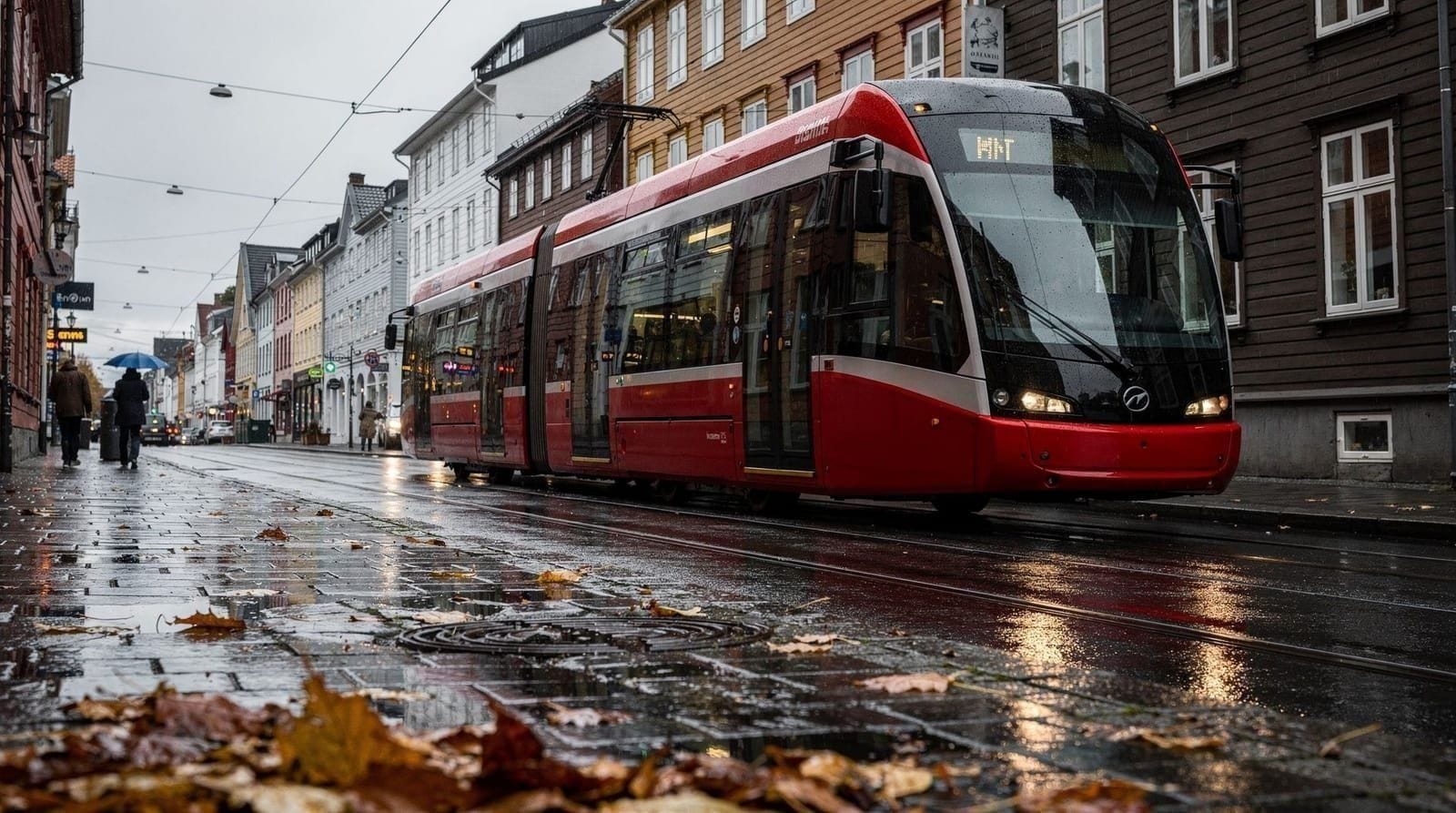
Bergen in the rain: how to plan when it's wet
Bergen: Past & Present Small Group Guided Walking Tour
What do you do in Bergen when it rains?
Bergen rains roughly 230 days a year — locals do not stay home. The funicular still runs, Bryggen alleyways are best explored in drizzle, KODE museums and indoor market are good rain options, and fjord scenery is more dramatic in mist. Pack a proper waterproof jacket and plan rain days as part of the trip.
Bergen has a municipal nickname: “City of Rain.” With approximately 230 wet days per year and annual rainfall around 2,250 mm, Bergen sits among Europe’s wettest cities by a significant margin. Rain is not an aberration in Bergen — it is the baseline condition. The questions worth asking are not “will it rain?” but “how do I plan around it?”
| Where | City-wide — every main sight has a rain-day version |
| Cost | Museum day: NOK 400–600; free options exist too |
| Time needed | A full rain-day plan covers 6–8 hours easily |
| Getting there | On foot — all indoor options cluster near Bryggen |
| Best time | May is driest; Oct–Dec is wettest |
This guide is written from the perspective that rain will happen during your visit. Here is how to deal with it.
What rain in Bergen actually looks like
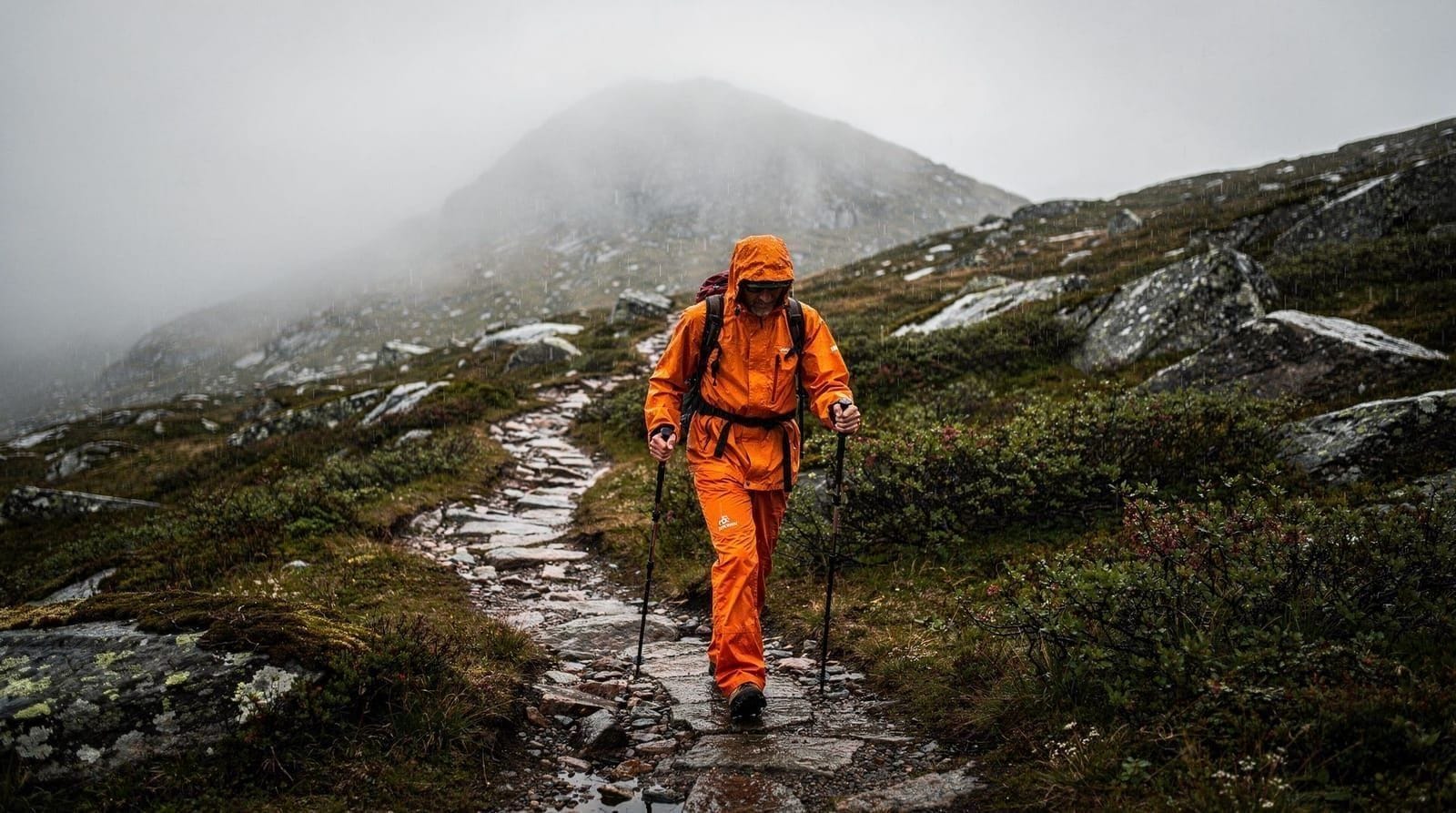
Bergen’s rain is rarely cinematic downpour. Most days bring persistent grey drizzle — the kind that soaks you gradually rather than immediately, that makes everything look lush and slightly misty, that locals clearly regard as unremarkable because they keep walking around in it without visible distress.
October through December brings the heaviest rainfall and occasional Atlantic storms. May is statistically the driest month, though it still rains. Summer rain tends toward afternoon showers after sunny mornings.
A rain day in Bergen does not mean a day stuck indoors. The city functions normally in rain. The Fløibanen funicular runs. The fish market’s indoor hall operates year-round. Restaurants and cafes are open. Bryggen’s alleyways — covered in part by the overhanging buildings — provide some natural shelter. Bergen locals would lose roughly 230 days of their lives annually if they let rain stop their activity.
If this is your first visit, the Bergen first-timer guide puts the main sights in order, and the best time to visit Bergen explains how the seasons change the odds. For a shorter, punchier take on the same subject, our rainy day in Bergen post is a good companion read.
The gear reality
The single most important factor in enjoying rainy Bergen is your rain jacket. A proper waterproof jacket with taped seams and a hood is not optional — it is the entry fee to functioning in this city. A jacket described as “water resistant” or “shower proof” will fail in Bergen’s persistent drizzle within an hour.
Waterproof shoes matter nearly as much. The cobblestones at Bryggen and throughout the old town become slippery when wet. Flat-soled fashion shoes or canvas sneakers on wet Bergen cobblestones are a trip-hazard problem, not just a comfort issue.
For more detail: what to pack for Bergen.
An umbrella is useful in sheltered spots but Bergen’s wind makes them problematic on exposed waterfront areas. Think of an umbrella as a backup, not a primary rain strategy.
What still works well in light-to-moderate rain
Bryggen alleyways
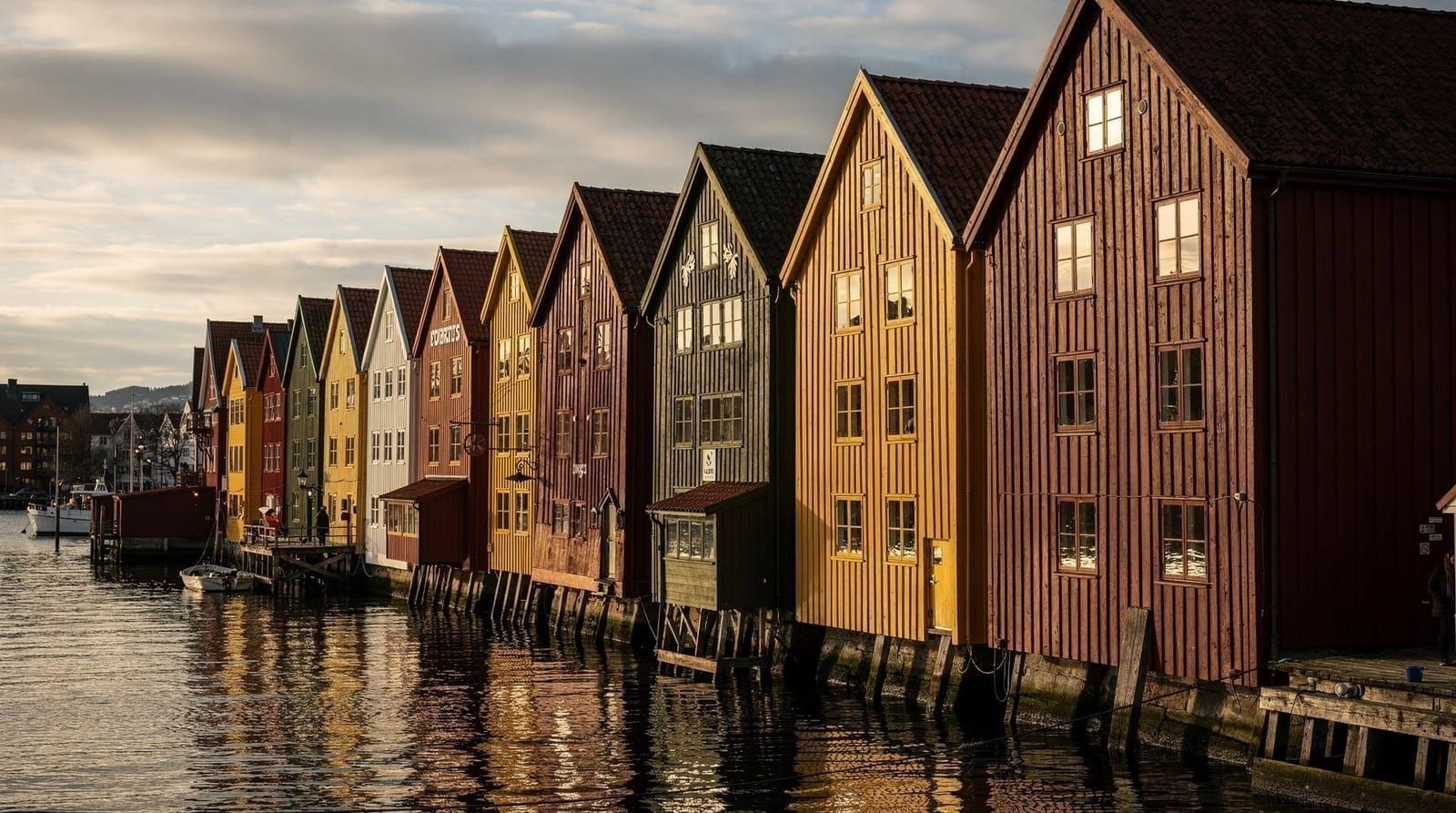
The narrow alleyways and courtyards behind the Bryggen frontage are one of Bergen’s most underrated experiences, and they are actually better in drizzle than in sunshine. The overhanging second floors of the timber buildings provide partial shelter, and the lack of direct sunlight on a grey day makes the warm-toned wood and the textures of the old structures easier to photograph. The crowds also thin significantly in rain — the people who came only for postcard photos leave, and the space becomes more manageable.
If you would rather have the history explained as you walk, a guided walk through old and modern Bergen is a sensible way to spend a drizzly morning in your waterproofs. For the full story of the wharf itself, read our Bryggen and Hanseatic Wharf guide.
Fløibanen funicular (with caveats)
The funicular still runs in rain. At the summit, the café and restaurant are open. In heavy cloud or mist, the panoramic view will be obscured — this is the honest caveat. But the mountain forest above the city is genuinely beautiful in fog: the trails disappear into white mist, the air smells of wet pine, and if you walk the paths you will understand why Bergen’s outdoor culture is genuinely all-weather rather than performative.
On days of low cloud, check whether the summit is in cloud before committing the full fare (NOK 220 return). Some days the cloud sits at 200 m — you go up, can see nothing, and come back. Other days the cloud sits higher and you have a panorama. There is no guaranteed answer; local weather apps (YR.no, operated by the Norwegian meteorological institute, is the most accurate for Bergen) give cloud height forecasts.
Our Fløibanen funicular guide covers the ride itself, and the Mount Fløyen guide has more on the trails and what to do once you are at the top, which matters if the weather turns while you are up there.
Walking the harbor and waterfront
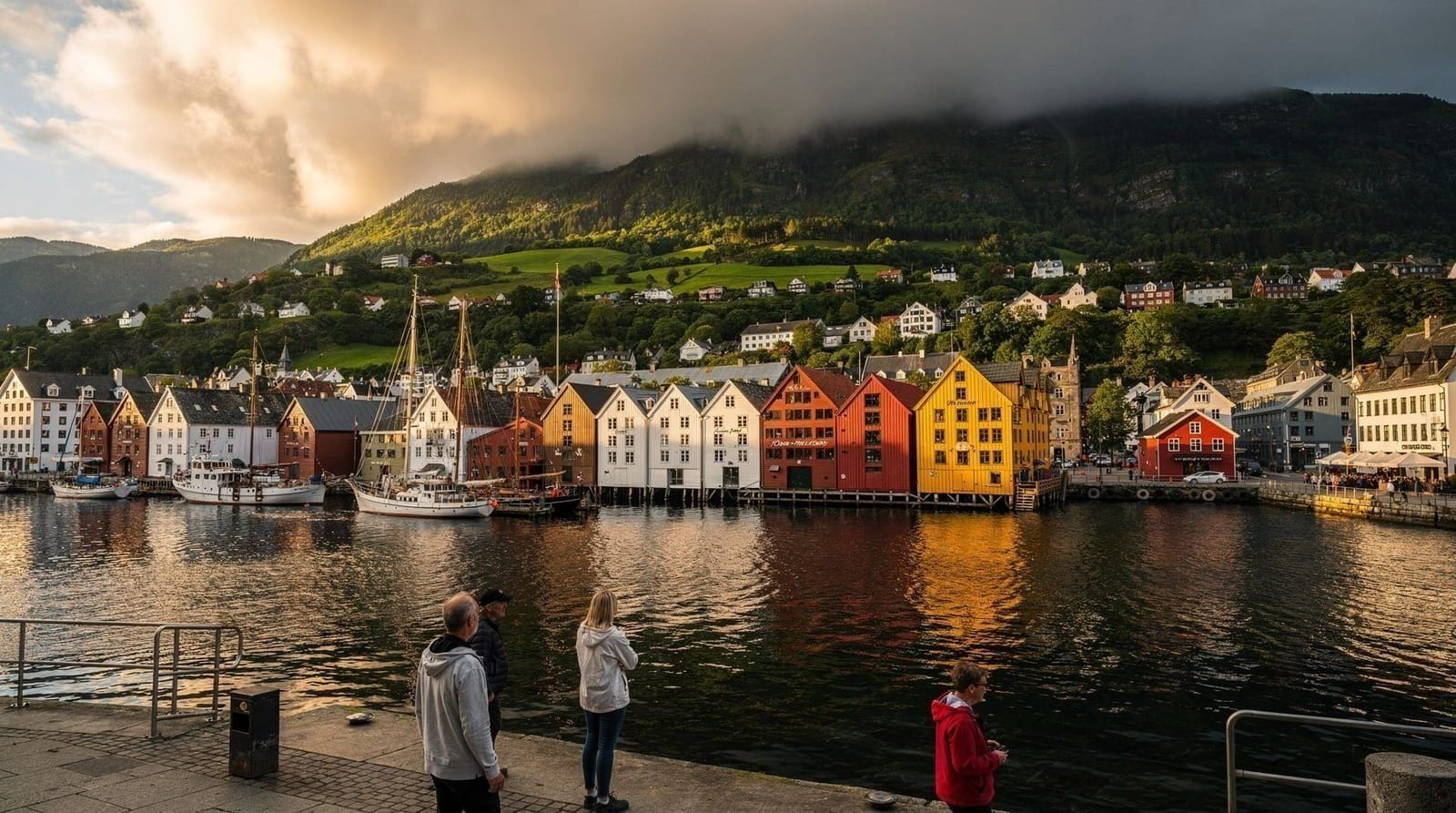
The Bergen harbor front — from Bryggen south past the Fish Market and along the promenade toward the Nordnes peninsula — is best walked in waterproof gear, but it is walkable in virtually any weather short of a genuine storm. The dramatic interplay of heavy cloud over the mountain backdrop, the moored wooden boats, and the grey fjord water is not unattractive. Bergen’s light in overcast conditions is consistently interesting for photography in a way that flat-grey cities are not.
Fish Market indoor hall (Fisketorget)
The outdoor stalls at the Fish Market operate in summer (roughly May–September, weather permitting). The indoor Fisketorget hall operates year-round. This is where locals actually shop — fresh fish, shellfish, smoked salmon, and a range of prepared food. On a rainy day it is warm, fragrant and genuinely interesting. It doubles as a legitimate lunch option. For a fuller picture of Bergen’s food scene beyond the market, see our food and drink guide.
Indoor activities in Bergen
KODE art museums
Bergen’s KODE complex is one of the best reasons to have a rainy day planned. The four KODE buildings around Lille Lungegårdsvann lake contain:
- KODE 1 (Permanenten): decorative arts, furniture, crafts, including an extensive collection of silver
- KODE 2: Norwegian and international fine art, with rotating exhibitions
- KODE 3: Edvard Munch’s early work (Bergen collection), plus design and architecture
- KODE 4: Major contemporary and 20th-century art
Individual building entry: NOK 140–180. All four buildings: use the Bergen Card for free access. A rainy half-day in KODE 3 and 4 is time well spent and justifies the Bergen Card on its own for many visitors. For the full breakdown of what each KODE building holds, see our Bergen museums and culture guide.
Bryggens Museum
Below-ground museum directly adjacent to the Bryggen wharf, showing the archaeological excavations that revealed 12th–14th century Hanseatic remains after the 1955 fire. The exhibitions are well-presented and give context to what you see walking the wharf above. Entry: NOK 130. Not large — 1.5 hours is enough.
Bergenhus Fortress and Håkon’s Hall
The fortress complex north of Bryggen includes Bergenhus Fortress Museum and the medieval Håkon’s Hall banqueting hall (13th century). The fortress grounds are free to walk even in rain. The interior of Håkon’s Hall is open for guided tours. Entry: NOK 120. A credible rain option that most first-timers overlook in favor of more prominent sights.
Theta Museum
A tiny museum in a reconstructed attic room above Bryggen that documents Bergen’s WWII resistance network. Only 3–4 rooms, but genuinely moving. Open weekend afternoons (hours vary; confirm before visiting). Entry: ~NOK 80.
Colonialen Mathall
Bergen’s best food hall, at Nedre Korskirkeallmenning 4, a few minutes from Bryggen. Not a tourist attraction but a working food market with excellent coffee, artisan bread, cheese, charcuterie, and prepared food counters. On a rainy afternoon it is warm, fragrant and good for a long lunch or coffee break that feels local rather than touristic.
Galleriet shopping center
If rain genuinely defeats your outdoor plans, Bergen’s main indoor mall is on Torgallmenningen (the main pedestrian square). Unremarkable as shopping centers go, but dry and warm.
Rain and fjord day trips: manage expectations
Most fjord day trips from Bergen continue in rain. The Norway in a Nutshell circuit (Bergen → Myrdal → Flåm Railway → Nærøyfjord cruise → Voss → Bergen) operates regardless of weather. The practical considerations:
Fjord scenery in rain can be more dramatic than in sun: The waterfalls along the Flåm Railway and the fjord walls on the Nærøyfjord cruise are fed by rain. In wet weather, waterfalls run heavy and the mist effects on the fjord walls are genuinely atmospheric. Many photographs taken in overcast wet conditions are more interesting than equivalent shots in flat-light sunshine.
Mountain viewpoints will be obscured: The Stegastein viewpoint above Flåm and other high-altitude panorama points will be in cloud on bad weather days. Factor this in.
The Flåm Railway is enclosed: The train itself is a comfortable, heated, enclosed experience regardless of weather outside.
Fjord cruises are partially covered: Most modern fjord cruise boats have indoor cabin areas. You can watch fjord scenery from inside in driving rain. The outdoor decks are usually still worth a brief visit even in rain — fjords in mist are not a bad experience.
Bergen: Viking Village, Nærøyfjorden Cruise and Flåm RailwayFor the details of each leg, see the Nærøyfjord cruise guide, the Flåm Railway guide and the Norway in a Nutshell guide. If you would rather stay closer to Bergen, fjord cruises from Bergen lists the shorter options, and a Mostraumen fjord cruise with a live guide is one way to see the fjord scenery without a full-day commitment. The best day trips from Bergen guide helps you choose which ones are worth keeping on a wet forecast.
How Bergen locals deal with rain
Observation from living at this latitude: Bergen locals wear proper rain gear as a matter of course. A Norrøna or Helly Hansen jacket (both Norwegian brands) is essentially the city uniform. Children in Bergen are sent to school in rain gear and rubber boots. The culture is emphatically not one of canceling outdoor plans when it drizzles.
The psychological shift that makes Bergen enjoyable in rain is treating the weather as a condition to dress for rather than an obstacle to overcome. Once you are appropriately geared up, Bergen’s rain becomes a backdrop rather than a problem. The city looks beautiful in grey light. The fjords are more atmospheric when mist hangs over the water.
This is not a sales pitch for rain — it would obviously be nicer to have sunshine. But Bergen’s rain is not the trip-ruiner some travelers expect. The travelers who have the worst weather experiences are almost always under-dressed for it.
Rain photography in Bergen
If you are visiting Bergen with a camera, rain days produce different and often better images than sunny days:
- Reflections in wet cobblestones at Bryggen (early morning, no crowds)
- Mist on Fløyen: from the funicular or the summit, cloud-level views are available only in damp conditions
- Fjord waterfalls in heavy flow: rain swells the waterfalls along the Flåm Railway and on the Hardangerfjord to their most spectacular
- Dramatic skies over Bryggen: Bergen’s weather produces the kind of dramatic cloud formations that make architectural photography interesting
Use a rain cover for your camera (inexpensive, packable). Bergen’s drizzle is not violent but sustained exposure will eventually saturate an uncovered camera body.
Rain day in Bergen: a sample schedule
Morning (9 am): Walk Bryggen alleyways in light rain — quieter than sunny days. Buy coffee from Kafe Knøget (inside a historic Bryggen building) or similar near-Bryggen café.
Mid-morning (10:30 am): Bryggens Museum — understand what is underneath Bryggen, 1.5 hours.
Noon: Fisketorget indoor hall for lunch — fresh shrimp, fish soup, or smoked salmon. NOK 120–200 for a meal.
Afternoon (1:30 pm): KODE 3 and KODE 4 — Edvard Munch and contemporary Norwegian art. 2–3 hours.
Late afternoon (4:30 pm): Fløibanen if cloud has lifted (check YR.no). If still in cloud, walk the Nordnes peninsula waterfront instead — quiet neighborhood, good harbor views.
Evening: Dinner at Pingvinen (Vaskerelven 14) for traditional Norwegian food at mid-range prices, or Lysverket (in KODE building, more expensive but one of Bergen’s serious restaurants).
A well-planned rain day in Bergen covers four significant experiences without the disappointment of staring at obscured views.
Frequently asked questions about Bergen rain
How many rainy days does Bergen have per year?
Bergen receives precipitation on approximately 230 days per year, with annual rainfall around 2,250 mm. It is one of the wettest cities in Europe.
Does rain ruin a trip to Bergen?
Not if you are prepared for it. Bergen functions normally in rain. The key is proper waterproof gear (jacket, shoes) and a mental framework that treats rain as a condition to dress for, not an obstacle. Many visitors report that Bergen in light rain is atmospheric and beautiful in a way that sunshine does not produce.
What months are driest in Bergen?
May is statistically Bergen’s driest month. June is also relatively drier than autumn months. October–December brings the heaviest rainfall. No month guarantees dry weather.
Is the Fløibanen worth taking in the rain?
In light rain, yes — the mountain trails and forest are beautiful in damp conditions. In heavy cloud that obscures the summit view, check YR.no first. If the cloud ceiling is at 200 m or below, the summit panorama will not be visible.
Can you do Norway in a Nutshell in rain?
Yes — the Norway in a Nutshell circuit operates in all weather. The Flåm Railway train is enclosed and comfortable. The Nærøyfjord cruise has indoor areas. Waterfalls are more impressive in wet conditions. High viewpoints will be obscured if cloud is low.
What rain gear do I actually need for Bergen?
A waterproof jacket with taped seams and a hood (not just water-resistant), waterproof shoes or boots, and optionally waterproof trousers for hiking days. See what to pack for Bergen for the full list.
Are there good indoor activities in Bergen for a full rainy day?
Yes: KODE art museums (four buildings, half a day), Bryggens Museum (1.5 hours), Bergenhus Fortress interior (1 hour), Fisketorget indoor market (lunch stop), Colonialen Mathall (food hall coffee break). A full rainy day in Bergen can be well-occupied indoors.
Do fjord cruises get cancelled for rain?
No, ordinary rain does not cancel fjord cruises or the Fløibanen — both operate as normal. Cancellations happen only during genuine storm warnings, which are relatively rare and concentrated in autumn and winter. Check YR.no for warning status if traveling October through February.
Is it worth visiting Bergen if the forecast is rain the whole trip?
Yes. A week of persistent Bergen drizzle is unpleasant but entirely survivable with the right gear, and the city’s indoor options (KODE, Bryggens Museum, Mathallen) plus rain-tolerant outdoor sights (Bryggen alleyways, the Fløibanen) genuinely fill several days. Many visitors who arrive expecting a washout report the mist and grey light growing on them.
Rainy Bergen for specific traveler types
Families with children
Bergen in the rain with children is manageable if you front-load indoor activities and use the Fløibanen as an any-weather anchor. The Troll Forest at the top of Fløyen has covered areas and the funicular ride itself is a draw for children regardless of weather.
Akvariet (Bergen Aquarium) at Nordnes is a 2-hour indoor activity fully enclosed — penguins, seals, fjord fish, and a children’s touch pool. Entry: NOK 320 adult, NOK 200 child. On a rainy day with children under 10, this is the strongest single choice in Bergen. See our Bergen city sightseeing guide for how it fits alongside the main sights.
The KODE museums have a children’s workshop (KODE Barn) in KODE 3 — activities change by season, worth checking the program in advance.
Photographers
The best Bergen photographs are often taken in grey weather:
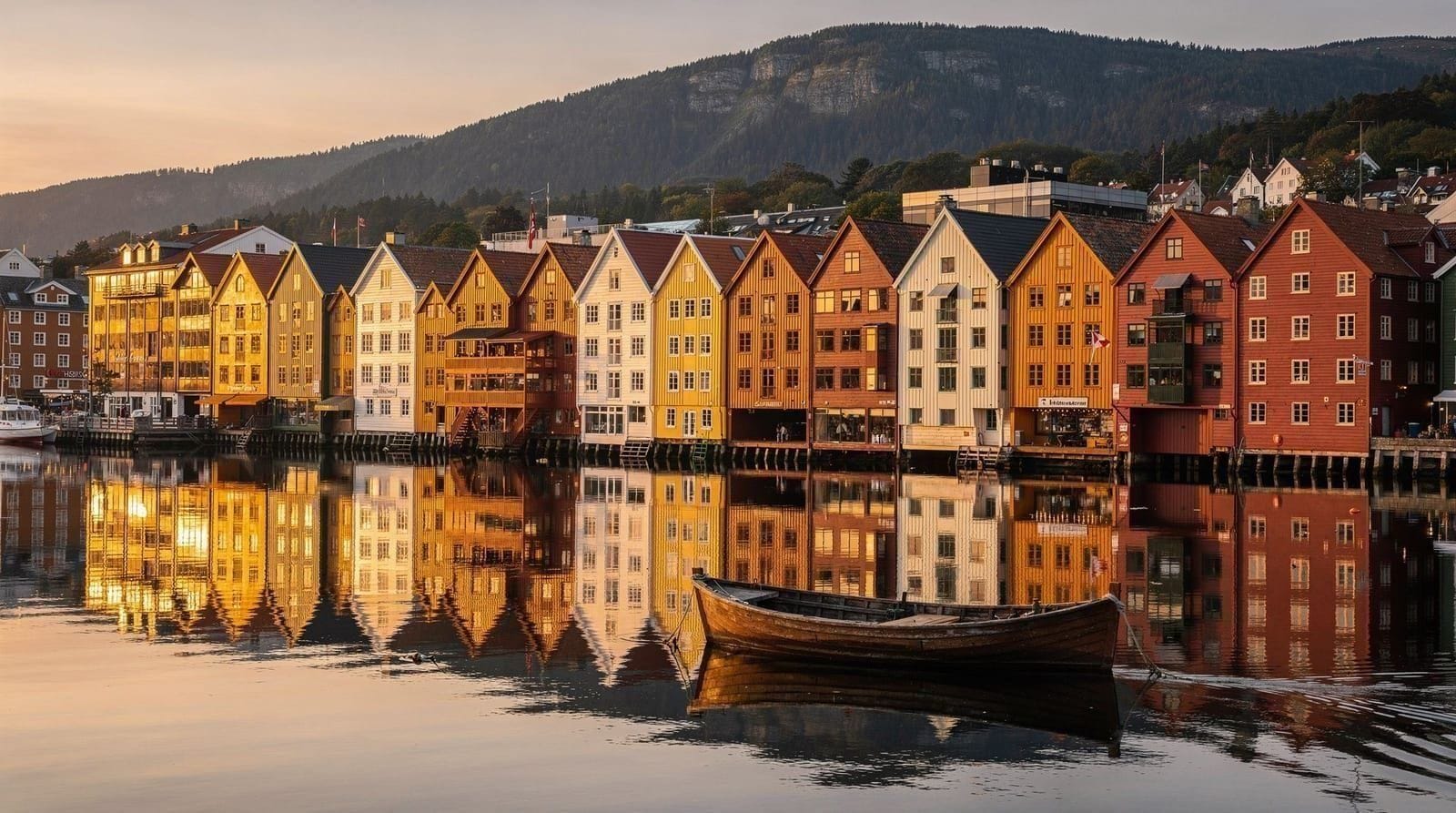
- Bryggen reflections: wet cobblestones create mirror reflections of the wooden facades — one of Bergen’s most distinctive and uncommon shots
- Fløyen in cloud: not a panoramic day, but close-up forest and mountain textures with mist are atmospheric
- Fish Market: the covered stalls in light rain, with vendors and their catch and the activity of a working market under grey skies, produce images that convey Bergen’s actual daily character rather than the promotional sunny version
- Bergenhus Fortress walls: stone architecture in rain has a texture and weight that dry conditions flatten
Protect your camera (a rain cover or large zip-lock bag works). Bergen’s drizzle is not violent but sustained horizontal exposure will eventually saturate an uncovered DSLR body.
Business and remote-work travelers
Bergen has a reasonable stock of cafés and co-working-friendly spaces for anyone combining a trip with remote work on a rain-heavy day. Colonialen and Blom both tolerate extended laptop sessions with a purchase, and hotel lobbies in the mid-range and above generally have decent Wi-Fi and quiet corners. If a full working day is needed, a rainy day is arguably the easiest day to schedule it — you lose nothing by trading a grey, low-visibility morning for a few hours of work before switching to KODE or Mathallen in the afternoon once the rain eases.
Solo travelers
Rain days in Bergen are excellent for museum-hopping, which is inherently a solo-pace activity. KODE’s four buildings provide 3–4 hours of content spread across them. The indoor fish market provides a social, market-atmosphere lunch. The Fløibanen gives a structured excursion even in light rain.
Café culture in Bergen is good for solo travelers: Colonialen and Kafe Kippers (near Nøstet) both have working-café atmospheres where extended laptop time or reading is normal, not unusual.
Couples
Bergen in the rain is actually better for couples than for groups — smaller, quieter, more intimate. The alleyways of Bryggen without crowds, a long KODE afternoon, dinner at a proper restaurant (try Lysverket in the KODE 4 building — one of Bergen’s most interesting kitchens), and a clear evening for the Fløibanen if the weather lifts.
Bergen’s rain compared to other rainy travel destinations
Context helps. Bergen gets 2,250 mm of rain per year. For comparison:
- London: ~600 mm/year
- Amsterdam: ~800 mm/year
- Edinburgh: ~700 mm/year
- Vancouver (Canada): ~1,200 mm/year
- Queenstown (New Zealand): ~900 mm/year
Bergen is genuinely among Europe’s wettest cities — significantly wetter than any other major European destination. But it is not a monsoon environment. The rain is spread across the year as persistent drizzle, not concentrated into a wet season. And Bergen’s outdoor infrastructure (funicular, cable car, enclosed museums, covered market) is designed to work in this climate.
The experience most comparable to Bergen’s rain culture is the Pacific Northwest (Seattle, Vancouver) — cities that maintain strong outdoor cultures despite significant annual rainfall by treating waterproofs as standard equipment rather than special-occasion gear.
Getting weather updates during your Bergen visit
YR.no is the tool. The Norwegian Meteorological Institute operates this service with hyperlocal Bergen data. The hourly forecast for central Bergen (search “Bergen sentrum”) gives rain probability, wind, temperature and cloud ceiling height for each hour of the day.
The cloud ceiling height is particularly useful: if YR.no shows cloud ceiling at 500 m for the morning but 900 m by early afternoon, that means Fløyen (320 m) will have views in the afternoon even if the morning is obscured. This allows intelligent scheduling — museums in the morning, funicular in the afternoon if the cloud lifts — rather than arriving at the summit and finding it in fog with no warning.
YR.no’s Bergen forecasts are noticeably more accurate than generic international weather apps (Weather.com, AccuWeather, Google Weather) for this specific location. Use it.
Rain-proofing a multi-day Bergen itinerary
If you have several days in Bergen, the smart approach is to build flexibility into your schedule rather than fixing every day to a specific activity in advance. Check YR.no the evening before and the morning of each day, and shuffle outdoor-dependent plans (Fløibanen for the view, harbor walks, day trips with viewpoints) toward the driest windows, while keeping indoor options (KODE, Bryggens Museum, Mathallen) as your default for the wettest stretches.
Booking your Fløibanen or fjord cruise slot only a day or two ahead, rather than weeks out, gives you this flexibility — most of Bergen’s rain-affected activities do not require the multi-week advance booking that, say, the Flåm Railway in July does. For a longer stay, our how many days in Bergen guide covers how to structure a multi-day visit with this kind of weather buffer built in. If you only have a short stay, the 2-day Bergen itinerary is easy to rearrange around the forecast, swapping outdoor and indoor blocks as the weather dictates. Moving between sights is simple in wet weather too; see getting around Bergen for the practical options.
Rain versus genuine storms
It is worth distinguishing Bergen’s routine drizzle from the occasional autumn and winter Atlantic storm. Ordinary rain days do not disrupt the Fløibanen, fjord cruises, or ferries. Genuine storm warnings (issued by the Norwegian Meteorological Institute, visible on YR.no as a colored warning banner) are different — the Fløibanen can suspend operations in high wind, and some fjord boat departures are cancelled for passenger safety. These are relatively rare and concentrated in the October–February window; if you are traveling then, check YR.no’s warning status each morning rather than assuming a light-rain forecast covers the full risk.