Trolltunga hike guide: the honest assessment for 2025
Full Day Hiking Adventure from Bergen to Trolltunga
How hard is the Trolltunga hike and can I do it without a guide?
Trolltunga is a demanding mountain hike: 20–28 km round trip (depending on trailhead), 700–1,200 m elevation gain, 10–14 hours. Self-guided hiking is permitted June 1–September 30 in normal conditions. Outside this window, or in snow/ice, a licensed guide and crampons are legally required. This is not a casual day hike — assess your fitness honestly before booking.
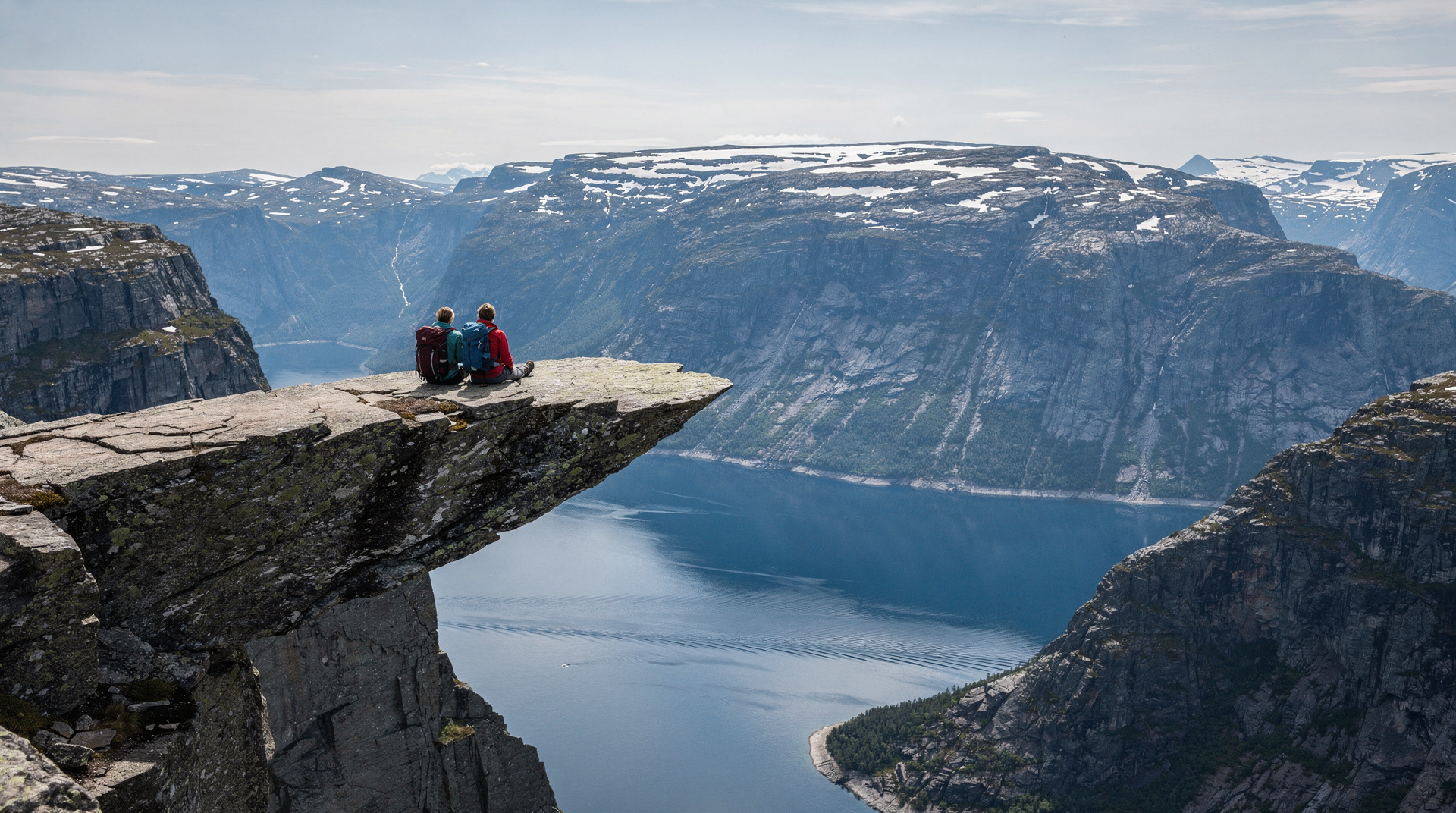
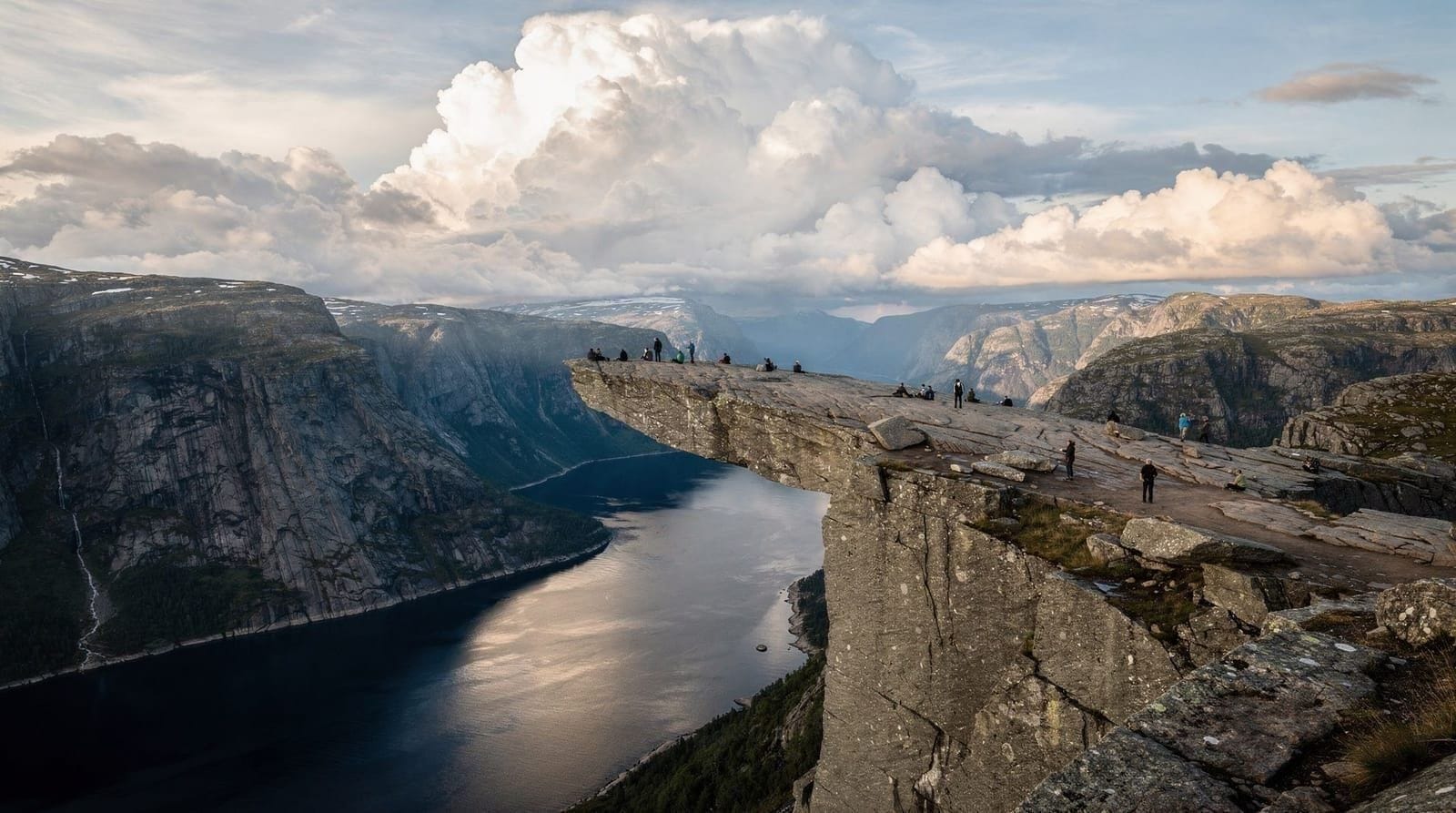
Trolltunga is one of Norway’s most photographed landscapes — a rock ledge hanging 700 m above Lake Ringedalsvatnet, extending horizontally from the cliff face as if it were a tongue. The photograph is extraordinary. The hike to reach it is genuinely demanding. This guide covers both honestly.
| Distance | 20–28 km round trip (P2 vs. P3 start) |
| Time needed | 10–14 hours, full day |
| Elevation gain | 700–1,200 m |
| Getting there | Bergen → Odda, around 3–3.5 hrs by car |
| Guide required | Oct 1 – May 31, or in snow/ice |
| Best time | Mid-June to early September |
The reality of this hike
Let us start with the numbers: 20–28 km round trip (depending on which trailhead you start from), 700–1,200 m elevation gain, 10–14 hours on the trail. This puts Trolltunga in the category of demanding mountain hikes that require real preparation — not in the category of “moderate nature walk” that some travel blog descriptions imply.
Each season, Norsk Luftambulanse (the Norwegian air ambulance) and mountain rescue teams conduct multiple rescue operations on the Trolltunga trail. The reasons are consistently the same: hikers who underestimated the distance, started too late, wore inadequate footwear, ran out of water or food, or were caught by weather that changed rapidly.
This is not a reason to avoid Trolltunga. It is a reason to go prepared.
Getting there from Bergen
By car (recommended for flexibility): Bergen → Voss → Odda → Tyssedal/Skjeggedal trailhead. Approximately 180 km, 3–3.5 hours. Google Maps tends to underestimate Norwegian mountain road driving times — add 30 minutes for rest stops and potential road delays.
By public transport: Bergen → Odda by Nettbuss (3–4 hours depending on connection), then local taxi or shuttle from Odda to Tyssedal. Check Skyss and Vy for current timetables. This works but adds significant time and cost for the taxi segment.
Guided day tour from Bergen: Several operators run full-day guided tours from Bergen (5:30–6:00 am departure, returning 11 pm–midnight). This is the most practical option for visitors without a car who want a single-day Trolltunga experience. The guide handles transport logistics and trail navigation.
Full Day Hiking Adventure from Bergen to TrolltungaTrailheads and shuttle bus
Two starting points:
P3 (Tyssedal/Skjeggedal, lower): The original and most strenuous start. From P3, the full elevation gain is 1,200 m over 14+ km one-way. This is the traditional route, now used mainly by those who want the maximum challenge or arrive early when the P2 shuttle has not yet started.
P2 (Mågelitopp shuttle endpoint): A shuttle bus from Odda/Tyssedal takes hikers partway up to Mågelitopp (NOK ~90 per way, runs from mid-June through September). Starting from P2 reduces the round trip to approximately 20 km and 700 m elevation gain. This is the standard approach for most day hikers.
Parking: P3 and the shuttle departure points charge NOK 250 per day. Payment by app or card machine. Parking fills early in July and August — arrive before 7 am or the parking area is full and you waste 30–60 minutes finding alternatives.
Season and guide requirements
June 1 – September 30 (standard season): Self-guided hiking is permitted in snow-free conditions. Weather can still turn rapidly. Start before 7 am in July to avoid peak crowds at the ledge and to give yourself buffer time before darkness (sunset is late in June/July — around 10:30 pm — but do not count on it).
October – May (off-season): A licensed mountain guide and crampons are required by Norwegian authorities. This is taken seriously. Trail patrol (fjellvakt) checks at trailheads during this period. Attempting Trolltunga without a guide in shoulder-season snow conditions is both dangerous and against regulations.
Early June and late September: Conditions vary significantly by year. Snow can persist at higher elevations in early June and return in October. Check Yr.no (the Norwegian weather service) and the local trail conditions report at trolltunga.no before departing.
Odda: Overnight Hike to TrolltungaThe route in sections
Shuttle stop (P2/Mågelitopp) → Tjørnane lakes (2.5–3 hours): The first section is a sustained ascent through the mountain plateau on rocky trail, gaining the majority of the elevation. The terrain is open moorland with excellent views back toward Odda and the Sørfjord. This section tests fitness early — if you are struggling at the 2-hour mark, turn back honestly.
Tjørnane lakes → Trolltunga (1.5–2 hours): After the lakes, the terrain levels slightly and becomes more dramatic, with high-altitude views opening toward the Ringedalsvatnet reservoir. The final approach is across exposed plateau with the drop becoming visible on the left.
At the ledge: In July and August, queues form for the famous photograph position. Wait times can be 15–45 minutes. There is no barrier or safety infrastructure. The ledge is solid rock and wider than it looks in photographs, but the exposure is real. Take your time, do not rush the position, and assess the rock surface (wet rock = significantly slippery). The surrounding scenery — lake 700 m below, ridge walking to the left and right — is worth exploring beyond just the ledge photo.
Return: Allow at least as long for the return as the ascent. Tired legs on downhill terrain increase injury risk. Most accidents on Trolltunga happen on the descent.
What guides add
A licensed Trolltunga guide provides pace management (critical for hikers who tend to go too fast early), navigation in poor visibility, first aid capability, and emergency protocol knowledge. They also know the route conditions day-to-day — where ice persists in early season, which sections become treacherous in rain.
For solo travelers or those unfamiliar with Norwegian mountain hiking, guided tours are the right choice — not because the trail is too technical to navigate, but because the margin for error on a 10–12 hour remote hike is low. A guide reduces that margin substantially.
Overnight option: staying at Trolltunga
Staying overnight in a tent at the Trolltunga plateau gives you the ledge at sunrise or sunset — conditions where the photography is incomparably better than the crowded midday peak and the light quality is different entirely. This requires carrying overnight equipment (tent, sleeping bag, stove, additional food) and adds 6–8 kg to your pack.
Organized overnight guided tours are available from Odda and Bergen — typically departing afternoon, camping at the plateau, summit at dawn, descent by mid-morning. These cost NOK 2,500–3,500 and include all equipment.
Practical preparation
Footwear is non-negotiable: Trail shoes with good grip are the minimum. Hiking boots with ankle support are better for the rocky terrain and significantly better for wet conditions. Road running shoes, sneakers, or sandals are not appropriate and consistently appear in accident reports.
Water: Carry 2.5–3 litres. There are natural water sources on the route (small streams) that locals consider safe to drink with a filter. Do not rely on finding water; carry what you need.
Weather: Check Yr.no specifically for Odda and the Folgefonna mountain area the morning of your hike. If wind speeds above 10 m/s are forecast at altitude, reconsider. Rain at altitude at Trolltunga is possible any month — a full waterproof system (jacket AND trousers) is essential.
Phone battery: Your phone will lose charge faster than normal in cold temperatures at altitude. A power bank is important if you are using your phone for navigation (and you should be).
Connecting Trolltunga to Bergen and the broader region
Trolltunga sits within the Hardangerfjord region. Combining a Trolltunga hike day with a Hardangerfjord cruise day from Odda/Eidfjord makes sense for a two-day structure in the region. The drive from Odda along Sørfjorden to the ferry point at Utne is one of the most scenic short drives in Norway.
For serious hikers, compare Trolltunga with Preikestolen — shorter (8 km, 4 hours) and more accessible, near Stavanger. The two are often described together as Norway’s iconic hikes. Trolltunga is significantly more demanding; Preikestolen is accessible for moderately fit hikers. The hiking around Bergen guide covers the city mountains for a warm-up day.
Where to stay near the trailhead
Odda is the practical base — a small town with supermarkets (Rema 1000), cafes, and several hotels and guesthouses within a short drive of the P2/P3 trailheads. Booking a room in Odda the night before means you can start the hike at first light without a 3-hour drive first, which meaningfully improves your chances of finishing before dark in shoulder season. Tyssedal, closer still to the trailhead, has a handful of smaller guesthouses and is worth checking for availability in July and August when Odda itself fills up.
If you would rather day-trip from Bergen without an overnight in Odda, the guided full-day tour is the more realistic option — it removes the need to drive yourself at 4–5 am after a short night’s sleep, which is when a meaningful share of trailhead driving incidents happen.
Training before you go
Trolltunga punishes hikers who arrive without any preparation. In the 4–6 weeks before your hike, build up to comfortably completing 15–18 km walks with some elevation gain — stairs, hills, or a loaded daypack on flat ground all help build the specific leg and cardio endurance the descent demands. If your fitness base is uncertain, a shorter warm-up hike earlier in your Bergen trip — Fløyen or Ulriken — is a realistic gauge: if either of those leaves you exhausted, reconsider Trolltunga or book the guided version, where pacing support matters most.
What actually goes wrong on the trail
The pattern in local rescue reports is consistent enough to be worth stating plainly: hikers start too late (after 9–10 am in peak season), underestimate the return leg, wear road shoes, or are caught by a weather change they had no waterproof layer for. None of these are exotic risks — they are the ordinary result of treating a 10–14 hour mountain hike like a long city walk. Checking what to pack for Bergen before your trip covers the layering and footwear detail this hike specifically demands.
Frequently asked questions about the Trolltunga hike
How crowded is Trolltunga?
In July, the trail can see 1,500–2,500 hikers per day and the ledge photo queue can stretch to 45 minutes. Mid-June and September are noticeably quieter. Starting before 6 am in peak season minimizes queues at the ledge.
Is Trolltunga suitable for beginners?
No — not without significant preparation. The distance and elevation gain exceed what most casual hikers manage comfortably. If your longest recent hike is under 15 km or you rarely hike more than 500 m elevation gain, start with shorter routes and work up to Trolltunga over multiple visits.
Are trekking poles useful for Trolltunga?
Yes — strongly recommended. The descent on rocky terrain with tired legs benefits significantly from pole support. They also help on wet or icy patches. If you do not own poles, many outdoor shops in Bergen and Odda rent them.
Can I hike Trolltunga in the rain?
Yes — the trail is hikeable in rain with proper gear. The ledge becomes more dangerous in wet conditions (slippery rock at the photo position). Many people complete Trolltunga in overcast or light rain conditions. Sustained heavy rain in cold temperatures changes the risk profile significantly. Make the decision on the day based on actual conditions, not forecasts made days in advance.
What happens if I am too slow and do not finish before dark?
June and July have very long evenings (no full darkness). In August and September, plan to be back at the shuttle stop before 8 pm. If you are behind schedule, turn back — the mountain is a better option the next time you visit than a rescue operation in fading light.
Is there food or water at the trailhead or on the route?
A small kiosk operates at the P2/Mågelitopp shuttle point in peak season with basic snacks and drinks. On the trail itself, no services. In Odda, there are cafes and a supermarket (Rema 1000) to provision before the hike.
Can I do Trolltunga and Preikestolen on the same trip?
Physically yes, if you allow 1–2 days of rest between them. They are in different regions (Odda vs. Stavanger) and not practical back-to-back without a transit day. A Western Norway 7-day itinerary can logically include both.
Is there a Trolltunga alternative that is easier?
For dramatic views with less effort, Preikestolen (Pulpit Rock, 8 km, ~4 hours) is the closest equivalent — also a famous ledge/platform over a fjord, significantly shorter. For Bergen-based hiking with real views but no extreme commitment, Ulriken (cable car up, hike around the summit) is excellent.
Top experiences
Bookable activities with verified prices and instant confirmation on GetYourGuide.